
Gutscheinbedingungen

**Gültig vom 15.06.2026 bis 17.06.2026 | Gültig für nicht preisgebundene fremdsprachige Bücher | Einzelne Artikel können ausgeschlossen sein | Maximaler rabattfähiger Warenkorbwert 500 € | Nicht kombinierbar mit weiteren Aktionen | Nur einmal pro Person einlösbar | Nur solange der Vorrat reicht

  • Produktbild: The Intellectual Powers
  • Produktbild: The Intellectual Powers

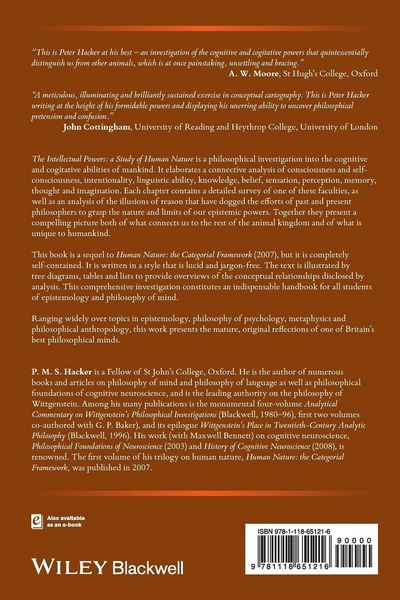
The Intellectual Powers A Study of Human Nature

44,99 €

inkl. gesetzl. MwSt., Versandkostenfrei

Lieferung nach Hause

Beschreibung

Produktdetails

Einband

Taschenbuch

Erscheinungsdatum

10.09.2013

Verlag

John Wiley & Sons Inc

Seitenzahl

490

Maße (L/B/H)

22,9/15,2/2,7 cm

Gewicht

626 g

Auflage

1. Auflage

Sprache

Englisch

ISBN

978-1-118-65121-6

Beschreibung

Rezension

"Peter Hacker is the most subtle and penetrating philosopher of the age. In recent years he has demolished the pretentions of cognitive neuroscience and caused outrage among fellow philosophers by showing that many of their claims are meaningless. The Intellectual Powers, his most recent book, is another masterpiece, examining the cognitive capacities of the human species. If, as the Ancient Greeks believed, philosophy is the most important subject, Hacker is one of our most seminal thinkers." (Matthew Syed, The Times, 7 December 2013)
"An essential guide and handbook for all who are working in philosophy of mind, epistemology, psychology, cognitive science, and cognitive neuroscience." (Expofairs.com, 21 November 2013)

Produktdetails

Einband

Taschenbuch

Erscheinungsdatum

10.09.2013

Verlag

John Wiley & Sons Inc

Seitenzahl

490

Maße (L/B/H)

22,9/15,2/2,7 cm

Gewicht

626 g

Auflage

1. Auflage

Sprache

Englisch

ISBN

978-1-118-65121-6

Herstelleradresse

Libri GmbH
Europaallee 1
36244 Bad Hersfeld
DE

Email: gpsr@libri.de

Kundinnen und Kunden meinen

0 Bewertungen

Informationen zu Bewertungen

Zur Abgabe einer Bewertung ist eine Anmeldung im Konto notwendig. Die Authentizität der Bewertungen wird von uns nicht überprüft. Wir behalten uns vor, Bewertungstexte, die unseren Richtlinien widersprechen, entsprechend zu kürzen oder zu löschen.

Die Bewertungen sind nach Format, Anzahl Sterne und Datum sortiert.

Verfassen Sie die erste Bewertung zu diesem Artikel

Helfen Sie anderen Kund*innen durch Ihre Meinung

Kundinnen und Kunden meinen

0 Bewertungen filtern

Die Leseprobe wird geladen.
  • Produktbild: The Intellectual Powers
  • Produktbild: The Intellectual Powers
  • Preface xi

    Introduction: The Project 1 Prolegomena 9

    Chapter 1 Consciousness as the Mark of the Mental 11

    1. Consciousness as a mark of modernity 11

    2. The genealogy of the concept of consciousness 15

    3. The analytic of consciousness 19

    4. The early modern philosophical conception of consciousness 33

    5. The dialectic of consciousness I 40

    6. The contemporary philosophical conception of consciousness 48

    7. The dialectic of consciousness II 51

    8. The illusions of self-consciousness 57

    Chapter 2 Intentionality as the Mark of the Mental 60

    1. Intentionality 60

    2. Intentional 'objects' 66

    3. The central sun: the relation of thought to reality 69

    4. The first circle: what do we believe (hope, suspect, etc.)? 82

    5. The second circle: the relation of language to reality 87

    6. The third circle: the relation of thought to language 91

    7. The fourth circle: the epistemology of intentionality 93

    8. The fifth circle: meaning and understanding 96

    Chapter 3 Mastery of a Language as the Mark of a Mind 101

    1. A language-using animal 101

    2. Linguistic communication 103

    3. Knowing a language 106

    4. Meaning something 111

    5. Understanding and interpreting 117

    6. Meaning and use 121

    7. The dialectic of understanding: the 'mystery' of understanding new sentences 136

    Part I The Cognitive and Doxastic Powers 145

    Chapter 4 Knowledge 147

    1. The value of knowledge 147

    2. The grammatical groundwork 149

    3. The semantic fi eld 154

    4. What knowledge is not 162

    5. Certainty 170

    6. Analyses of knowledge 175

    7. Knowledge and ability 180

    8. Knowing-how 186

    9. What is knowledge? The role of 'know' in human discourse 191

    Chapter 5 Belief 196

    1. The web of belief 196

    2. The grammatical groundwork 201

    3. The surrounding landscape 207

    4. Voluntariness and responsibility for belief 212

    5. Belief and feelings 218

    6. Belief and dispositions 221

    7. Belief and mental states 227

    8. Why believing something cannot be a brain state 230

    9. What is belief? The role of 'believe' in human discourse 232

    Chapter 6 Knowledge, Belief and the Epistemology of Belief 238

    1. Knowledge and belief 238

    2. The epistemology of belief 245

    3. Non-standard cases: self-deception and unconscious beliefs 251

    Chapter 7 Sensation and Perception 257

    1. The cognitive powers of the senses 257

    2. Sensation 262

    3. Perception and sensation 273

    4. Sensation, feeling and tactile perception 278

    Chapter 8 Perception 286

    1. Perceptual organs, the senses and proper sensibles 286

    2. Perceptual powers: cognition and volition 294

    3. The classical causal theory of perception 301

    4. The modern causal theory of perception 307

    Chapter 9 Memory 316

    1. Memory as a form of knowledge 316

    2. The objects of memory 320

    3. The faculty and its actualities 321

    4. Forms of memory 328

    5. Further conceptual links and contrasts 333

    6. The dialectic of memory I: the Aristotelian legacy 338

    7. The dialectic of memory II: trace theory 345

    Part II The Cogitative Powers 353

    Chapter 10 Thought and Thinking 355

    1. Floundering without an overview 355

    2. The varieties of thinking 361

    3. Is thinking an activity? 369

    4. What do we think in? 375

    5. Thought, language and the language of thought 387

    6. Can animals think? 393

    7. The agent, organ and location of thinking 397

    8. Thinking and the 'inner life' 401

    Chapter 11 Imagination 405

    1. A cogitative faculty 405

    2. The conceptual network of the imagination 409

    3. Perceiving and imagining 417

    4. Perceptions and 'imaginations': clarity and vivacity of mental imagery 422

    5. Mental images and imagining 426

    6. Imagination and the will 429

    7. The imaginable, the conceivable and the possible 431

    Appendix: Philosophical Analysis and the Way of Words 436

    1. On method 436

    2. Methodological objections and misunderstandings 452

    Index 464