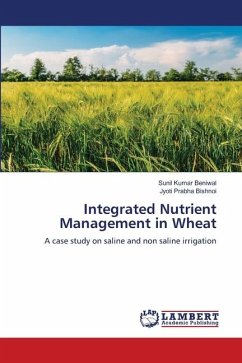
Integrated Nutrient Management in Wheat
A case study on saline and non saline irrigation
Versandkostenfrei!
Versandfertig in 6-10 Tagen
40,99 €
inkl. MwSt.

PAYBACK Punkte
20 °P sammeln!

Wheat (Triticum Spp.) has been described as "Staff of life or king of cereals" and one of the most important staple food crop. Wheat has its own outstanding importance as a human food; it is rich in carbohydrates and protein. A case study was conducted during rabi seasons on "Integrated nutrient management in wheat (Triticum aestivum L.)". The experiment results showed that effective tillers/mrl, ear head length (cm), number of grains/spike, grain, straw and biological yields (q/ha) were significantly higher in canal water as compared to saline water. Number of effective tillers/mrl, number of...
Wheat (Triticum Spp.) has been described as "Staff of life or king of cereals" and one of the most important staple food crop. Wheat has its own outstanding importance as a human food; it is rich in carbohydrates and protein. A case study was conducted during rabi seasons on "Integrated nutrient management in wheat (Triticum aestivum L.)". The experiment results showed that effective tillers/mrl, ear head length (cm), number of grains/spike, grain, straw and biological yields (q/ha) were significantly higher in canal water as compared to saline water. Number of effective tillers/mrl, number of grains/spike, grain, straw and biological yields (q/ha) were maximum in Azotobacter ST3 and Pseudomonas P36 + vermicompost @5 t/ha and minimum in no inoculation treatment. Application of 125% RDF, being statistically at par with 100% RDF, produced significantly higher number of effective tillers/mrl, grains/spike, grain, straw and biological yields (q/ha) than 75% RDF.
Andere Kunden interessierten sich für