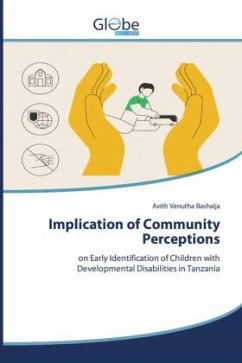
Implication of Community Perceptions
on Early Identification of Children with Developmental Disabilities in Tanzania
Versandkostenfrei!
Versandfertig in 6-10 Tagen
29,99 €
inkl. MwSt.

PAYBACK Punkte
15 °P sammeln!

This study investigates the implications of community perceptions on the early identification of children with developmental disabilities in Singida Municipal District, Tanzania. Guided by Bronfenbrenner's Social Ecological Systems Theory, it explores the experiences of professionals, the role of early identification in strengthening social support for families, and parental perceptions of socioeconomic factors influencing access to services. Using a qualitative phenomenological design, data were collected through in-depth interviews and focus group discussions with 29 participants, including ...
This study investigates the implications of community perceptions on the early identification of children with developmental disabilities in Singida Municipal District, Tanzania. Guided by Bronfenbrenner's Social Ecological Systems Theory, it explores the experiences of professionals, the role of early identification in strengthening social support for families, and parental perceptions of socioeconomic factors influencing access to services. Using a qualitative phenomenological design, data were collected through in-depth interviews and focus group discussions with 29 participants, including social welfare officers, nurses, special education teachers, parents, and community leaders. Findings reveal that early identification enhances access to specialized services and fosters parental empowerment but is constrained by stigma, cultural beliefs, financial hardship, limited training, and systemic resource shortages. The study concludes that strengthening community awareness, enhancing professional capacity, and addressing socioeconomic barriers are critical for timely identification and inclusive support.
Andere Kunden interessierten sich für