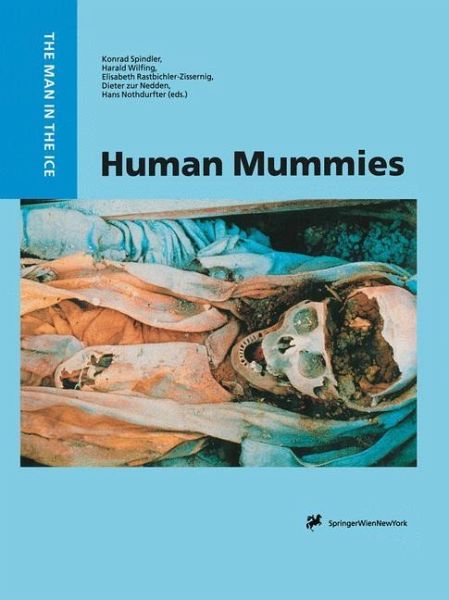
Human Mummies
A Global Survey of their Status and the Techniques of Conservation
Mitarbeit: Spindler, Konrad; Wilfing, Harald; Rastbichler-Zissernig, Elisabeth
Versandkostenfrei!
Versandfertig in 1-2 Wochen
153,99 €
inkl. MwSt.

PAYBACK Punkte
77 °P sammeln!

The contributions to the volume have their origin in a spontaneously organized meeting of experts at Innsbruck 1991 for finding the best measures for the conservation of the newly found "Man in the Ice". Due to their target the techniques of conservation of corpses all over the world are described: Smoke-drying (Ecuador), sun-drying (Canary Islands), natural mummification by combination of low temperatures and dry air (Eskimo mummies of Qilakitsoq); the reader also will find descriptions of permafrost mummies of Greenland and "bog-mummies" of North-West-Europe including new methods of investigation in the fields of roentgenological, microbiological, microscopical, and microchemical methods and the latest imaging techniques in medical archaeology.
On 15-17 September, 1993, Innsbruck, Austria, search. Another remarkable case, that of the pre-Colum hosted the International Mummy Symposium. This bian miner from Restauradora Mine near Chuqincamata does not mean that beautiful North Tyrol was the setting in northern Chile, is the result of impregnation with for a gathering of the world's most prominent mummies copper salts, and the mummy became an attraction as themselves, but rather the exciting discovery of a Late "Copper Man" at various fairs around the country. As he Neolithic glacial mummy released from the ice of the was found with a complete set of miner's tools, the Otztal Alps provided the focus of attention for numerous mummy offers a unique insight into the life and working scholars from many different parts of the world to come conditions of an Indio miner of the first millennium AD. together to address various questions relating to mum Even so, the mummified remains comprise only the skel mified human remains. etonwith a completely rigid covering of skin, whereas Normally researchers studying the remains of histori the other soft parts have not survived. calor prehistoric human bodies will at best have bony In contrast, mummification in ice, and especially in substance to work on. It is rarely the case that soft parts the permafrost, can produce much better results.
Andere Kunden interessierten sich für