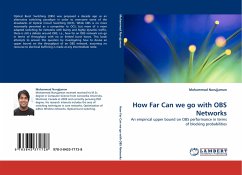
How Far Can we go with OBS Networks
An empirical upper bound on OBS performance in terms of blocking probabilities
Versandkostenfrei!
Versandfertig in 6-10 Tagen
39,99 €
inkl. MwSt.

PAYBACK Punkte
20 °P sammeln!

Optical Burst Switching (OBS) was proposed a decade ago as an alternative switching paradigm in order to overcome some of the drawbacks of Optical Circuit Switching (OCS). While OBS is no more necessarily perceived as a competitor to OCS, but more of a more adapted switching for networks with bursty and highly dynamic traffic, there is still a debate around OBS, i.e., how far an OBS network can go in terms of throughput with no or limited burst losses. This book attempts to answer this question by investigating how to devise an upper bound on the throughput of an OBS network, assuming no recou...
Optical Burst Switching (OBS) was proposed a decade ago as an alternative switching paradigm in order to overcome some of the drawbacks of Optical Circuit Switching (OCS). While OBS is no more necessarily perceived as a competitor to OCS, but more of a more adapted switching for networks with bursty and highly dynamic traffic, there is still a debate around OBS, i.e., how far an OBS network can go in terms of throughput with no or limited burst losses. This book attempts to answer this question by investigating how to devise an upper bound on the throughput of an OBS network, assuming no recourse to electrical buffering is made at any intermediate node.
Andere Kunden interessierten sich für