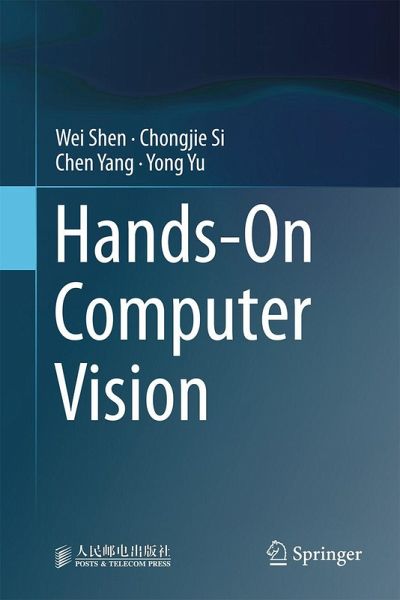
Hands-On Computer Vision
Versandkostenfrei!
Erscheint vorauss. 10. Februar 2026
57,99 €
inkl. MwSt.

Computer vision is an application-oriented field, where various applications correspond to distinct computer vision tasks. Consequently, this book is organized based on the taxonomy of these tasks: image processing, visual recognition, and scene reconstruction.Image processing, the foundational step, includes topics like convolution, edge detection, and image segmentation, often referred to as low-level vision tasks. This section covers classical algorithms. Visual recognition, or high-level vision, involves understanding image semantics and includes topics such as image classification, object...
Computer vision is an application-oriented field, where various applications correspond to distinct computer vision tasks. Consequently, this book is organized based on the taxonomy of these tasks: image processing, visual recognition, and scene reconstruction.
Image processing, the foundational step, includes topics like convolution, edge detection, and image segmentation, often referred to as low-level vision tasks. This section covers classical algorithms. Visual recognition, or high-level vision, involves understanding image semantics and includes topics such as image classification, object detection, and action recognition. Deep learning algorithms are highlighted here. Scene reconstruction focuses on recovering 3D structures from images and includes topics like camera calibration and 3D reconstruction, explored through geometry-based algorithms.
Each chapter is presented in Python Notebooks with theoretical explanations, algorithm details, and executable code, allowing readers to focus on text or implementation as needed. Designed for students, educators, researchers, and engineers, this book assumes familiarity with basic mathematics and Python programming.
The translation was done using artificial intelligence. Subsequently, a human revision was done primarily in terms of content.
Image processing, the foundational step, includes topics like convolution, edge detection, and image segmentation, often referred to as low-level vision tasks. This section covers classical algorithms. Visual recognition, or high-level vision, involves understanding image semantics and includes topics such as image classification, object detection, and action recognition. Deep learning algorithms are highlighted here. Scene reconstruction focuses on recovering 3D structures from images and includes topics like camera calibration and 3D reconstruction, explored through geometry-based algorithms.
Each chapter is presented in Python Notebooks with theoretical explanations, algorithm details, and executable code, allowing readers to focus on text or implementation as needed. Designed for students, educators, researchers, and engineers, this book assumes familiarity with basic mathematics and Python programming.
The translation was done using artificial intelligence. Subsequently, a human revision was done primarily in terms of content.
Andere Kunden interessierten sich für