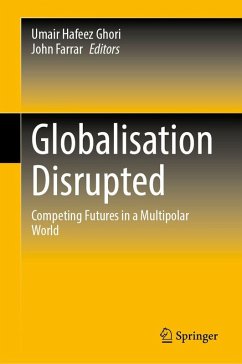
Globalisation Disrupted
Competing Futures in a Multipolar World
Herausgegeben: Ghori, Umair Hafeez; Farrar, John

PAYBACK Punkte
57 °P sammeln!

This book explores the complexities of globalization, examining its evolving role in a world characterized by increasing interdependence and tension. Globalization has enabled the free flow of people, capital, information, and trade, driving economic prosperity. However, its legitimacy is increasingly questioned, particularly as institutions that underpin the global economy continue to reflect post-World War II structures, favoring Western hegemonic actors while limiting the influence of developing nations. The rise of China and organizations like BRICS has amplified calls for more equitable r...
This book explores the complexities of globalization, examining its evolving role in a world characterized by increasing interdependence and tension. Globalization has enabled the free flow of people, capital, information, and trade, driving economic prosperity. However, its legitimacy is increasingly questioned, particularly as institutions that underpin the global economy continue to reflect post-World War II structures, favoring Western hegemonic actors while limiting the influence of developing nations. The rise of China and organizations like BRICS has amplified calls for more equitable representation and a rethinking of global economic governance.
The book presents a series of essays, offering diverse perspectives on key issues shaping the future of globalization. Unlike earlier works, this book emphasizes the broadening conception of geopolitical conflict, which now extends beyond the military sphere to include economic legitimacy. The contributions focus on theeconomic security implications of global developments, touching on themes such as nationalism, technological decoupling, and the shifting balance of power between the West and emerging economies.
Central to the book is the fragmentation of globalization, with discussions on the challenges posed by rising nationalism, protectionism, and the impact of major geopolitical shifts such as Brexit, China's Belt and Road Initiative, and the US-China rivalry. It also delves into the role of emerging economies in reshaping global trade dynamics, the challenges facing global institutions like the WTO, and the implications of technological advancements for global governance. Overall, this book offers a timely and critical analysis of globalization, exploring its stressors and future direction.
The book presents a series of essays, offering diverse perspectives on key issues shaping the future of globalization. Unlike earlier works, this book emphasizes the broadening conception of geopolitical conflict, which now extends beyond the military sphere to include economic legitimacy. The contributions focus on theeconomic security implications of global developments, touching on themes such as nationalism, technological decoupling, and the shifting balance of power between the West and emerging economies.
Central to the book is the fragmentation of globalization, with discussions on the challenges posed by rising nationalism, protectionism, and the impact of major geopolitical shifts such as Brexit, China's Belt and Road Initiative, and the US-China rivalry. It also delves into the role of emerging economies in reshaping global trade dynamics, the challenges facing global institutions like the WTO, and the implications of technological advancements for global governance. Overall, this book offers a timely and critical analysis of globalization, exploring its stressors and future direction.
Andere Kunden interessierten sich für