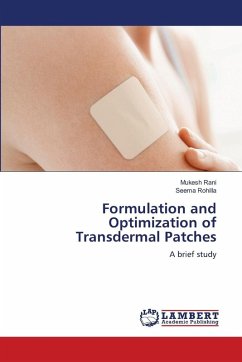
Formulation and Optimization of Transdermal Patches
A brief study
Versandkostenfrei!
Versandfertig in 6-10 Tagen
53,99 €
inkl. MwSt.

PAYBACK Punkte
27 °P sammeln!

Lisinopril is an antihypertensive agent indicated for the prevention of hypertension, acute myocardial infarction and diabetic nephropathy. It is an angiotensin converting enzyme(ACE) inhibitor. It has a short half-life and undergoes variable first pass metabolism. It is required to be administered two or three times daily which results in poor patient compliance. In this work an attempt was made to formulate & evaluate TDDS for sustained release of lisinopril by solvent evaporation method. Low molecular weight, good permeability and shorter half-life of the drug made it a suitable candidate f...
Lisinopril is an antihypertensive agent indicated for the prevention of hypertension, acute myocardial infarction and diabetic nephropathy. It is an angiotensin converting enzyme(ACE) inhibitor. It has a short half-life and undergoes variable first pass metabolism. It is required to be administered two or three times daily which results in poor patient compliance. In this work an attempt was made to formulate & evaluate TDDS for sustained release of lisinopril by solvent evaporation method. Low molecular weight, good permeability and shorter half-life of the drug made it a suitable candidate for the development of trans dermal patch.The main objective of formulating the transdermal system was to prolong the drug release time, reduce the frequency of administration and to improve patient compliance. The compatibility characterization was done by IR method. By using 32factorial design nine formulations were prepared using hydrophilic (HPMC) andhydrophobic (ethyl cellulose) polymersalong with selected plasticizer & permeationenhancer. PVA backing membrane was used as a substrate for pouring the polymeric solution. The prepared patches were evaluated for physical appearance, thickness.
Andere Kunden interessierten sich für