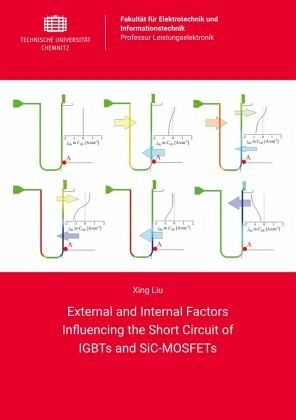
External and Internal Factors Influencing the Short Circuit of IGBTs and SiC-MOSFETs
Dissertationsschrift
Versandkostenfrei!
Versandfertig in 6-10 Tagen
25,90 €
inkl. MwSt.

PAYBACK Punkte
0 °P sammeln!

This work investigates the application-relevant short-circuit type II and III behaviours of discrete IGBTs and SiC-MOSFETs. Unlike the well-studied SC I, SC II and III involve complex dynamic processes, requiring a deeper physical understanding. External influencing factors such as gate driver design, gate resistance, package parasitics, and magnetic coupling are analysed experimentally, revealing their role in shaping gate voltage overshoot, current peaks, and induced overvoltages.Internally, TCAD simulations highlight the plasma effect in IGBTs, which significantly impacts current peak, deca...
This work investigates the application-relevant short-circuit type II and III behaviours of discrete IGBTs and SiC-MOSFETs. Unlike the well-studied SC I, SC II and III involve complex dynamic processes, requiring a deeper physical understanding. External influencing factors such as gate driver design, gate resistance, package parasitics, and magnetic coupling are analysed experimentally, revealing their role in shaping gate voltage overshoot, current peaks, and induced overvoltages.Internally, TCAD simulations highlight the plasma effect in IGBTs, which significantly impacts current peak, decay dynamics, and self-turn-off risks. Additionally, a novel channel potential modification-induced displacement current (CPiC) mechanism is introduced as a contributor to gate voltage overshoot, complementing the classical Miller effect. The SC type III introduces IGBT-diode interactions. Moreover, plasma effects in high-voltage SiC-MOSFETs under SC III are shown for the first time, with implications for dead time and gate bias optimisation. Overall, this dissertation provides new insights into short-circuit physics and suggests methods to improve the ruggedness of IGBTs and SiC-MOSFETs in demanding applications.
Andere Kunden interessierten sich für