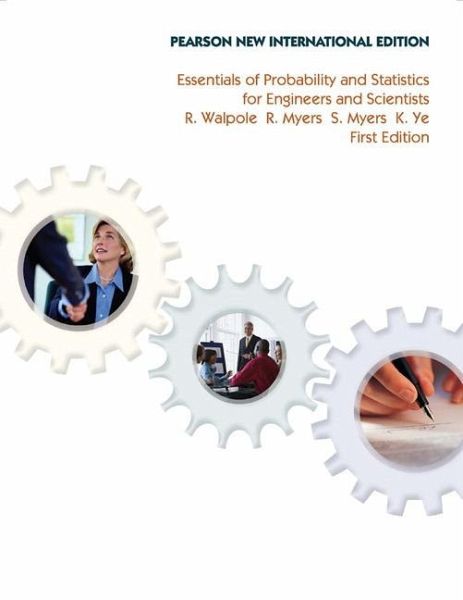
Essentials of Probability & Statistics for Engineers & Scientists
Pearson New International Edition
Versandkostenfrei!
Versandfertig in 2-4 Wochen
114,99 €
inkl. MwSt.

PAYBACK Punkte
57 °P sammeln!

For junior/senior undergraduates taking a one-semester probability and statistics course as applied to engineering, science, or computer science.
This text covers the essential topics needed for a fundamental understanding of basic statistics and its applications in the fields of engineering and the sciences. Interesting, relevant applications use real data from actual studies, showing how the concepts and methods can be used to solve problems in the field. Students using this text should have the equivalent of the completion of one semester of differential and integral calculus.
Features + Benefits
The balance between theory and applications offers mathematical support to enhance coverage when necessary, giving engineers and scientists the proper mathematical context for statistical tools and methods.
Case studies provide deeper insight into the practicality of the concepts.
Calculus is confined to elementary probability theory and probability distributions (Chapters1–3).
Linear algebra and the use of matrices are applied only in Section 7.11, where treatment of multiple linear regression and analysis of variance is covered.
Compelling exercise sets challenge students to use the concepts to solve problems that occur in many real-life scientific and engineering situations. Many exercises contain real data from studies in the fields of biomedical, bioengineering, business, computing, etc.
Real-life applications of the Poisson, binomial, and hypergeometric distributions generate student interest using topics such as flaws in manufactured copper wire, highway potholes, hospital patient traffic, airport luggage screening, and homeland security.
Class projects provide the opportunity for students to gather their own experimental data and draw inferences from that data. These projects illustrate the meaning of a concept or provide empirical understanding of important statistical results, and are suitable for either group or individual work.
Statistical software coverage in the following case studies includes SAS® and MINITAB®, with screenshots and graphics as appropriate:
Two-sample hypothesis testing
Multiple linear regression
Analysis of variance
Use of two-level factorial-experiments
Interaction plots provide examples of scientific interpretations and new exercises using graphics.
End-of-chapter material strengthens the connections between chapters.
“Pot Holes” comments remind students of the bigger picture and how each chapter fits into that picture. These notes also discuss limitations of specific procedures and help students avoid common pitfalls in misusing statistics.
Topic outline
Chapter 1: elementary overview of statistical inference and basic probability
Chapter 2: random variables, probability distributions, and expectations
Chapter 3: specific discrete and continuous distributions with illustrations of their use and relationships among them
Chapter 4: materials on graphical methods; an important introduction to the notion of sampling distribution
Chapters 5–6: one- and two- sample point and interval estimation, statistical hypothesis testing
Chapters 7–9: simple and multiple linear regressions; analysis of variance; multi-factorial experiments
1. Introduction to Statistics and Probability
1.1 Overview: Statistical Inference, Samples, Populations, and the Role of Probability
1.2 Sampling Procedures; Collection of Data
1.3 Discrete and Continuous Data.
1.4 Probability: Sample Space and Events
Exercises
1.5 Counting Sample Points
Exercises
1.6 Probability of an Event
1.7 Additive Rules
Exercises
1.8 Conditional Probability, Independence, and the Product Rule
Exercises
1.9 Bayes' Rule
Exercises
Review Exercises
2. Random Variables, Distributions, and Expectations
2.1 Concept of a Random Variable
2.2 Discrete Probability Distributions
2.3 Continuous Probability Distributions
Exercises
2.4 Joint Probability Distributions
Exercises
2.5 Mean of a Random Variable
Exercises
2.6 Variance and Covariance of Random Variables.
Exercises
2.7 Means and Variances of Linear Combinations of Random Variables
Exercises
Review Exercises
2.8 Potential Misconceptions and Hazards; Relationship to Material in Other Chapters
3. Some Probability Distributions
3.1 Introduction and Motivation
3.2 Binomial and Multinomial Distributions
Exercises
3.3 Hypergeometric Distribution
Exercises
3.4 Negative Binomial and Geometric Distributions
3.5 Poisson Distribution and the Poisson Process
Exercises
3.6 Continuous Uniform Distribution
3.7 Normal Distribution
3.8 Areas under the Normal Curve
3.9 Applications of the Normal Distribution
Exercises
3.10 Normal Approximation to the Binomial
Exercises
3.11 Gamma and Exponential Distributions
3.12 Chi-Squared Distribution.
Exercises
Review Exercises
3.13 Potential Misconceptions and Hazards; Relationship to Material in Other Chapters
4. Sampling Distributions and Data Descriptions
4.1 Random Sampling
4.2 Some Important Statistics
Exercises
4.3 Sampling Distributions
4.4 Sampling Distribution of Means and the Central Limit Theorem
Exercises
4.5 Sampling Distribution of S2
4.6 t-Distribution
4.7 F-Distribution
4.8 Graphical Presentation
Exercises
Review Exercises
4.9 Potential Misconceptions and Hazards; Relationship to Material in Other Chapters
5. One- and Two-Sample Estimation Problems
5.1 Introduction
5.2 Statistical Inference
5.3 Classical Methods of Estimation.
5.4 Single Sample: Estimating the Mean
5.5 Standard Error of a Point Estimate
5.6 Prediction Intervals
5.7 Tolerance Limits
Exercises
5.8 Two Samples: Estimating the Difference between Two Means
5.9 Paired Observations
Exercises
5.10 Single Sample: Estimating a Proportion
5.11 Two Samples: Estimating the Difference between Two Proportions
Exercises
5.12 Single Sample: Estimating the Variance
Exercises
Review Exercises
5.13 Potential Misconceptions and Hazards; Relationship to Material in Other Chapters
6. One- and Two-Sample Tests of Hypotheses.
6.1 Statistical Hypotheses: General Concepts
6.2 Testing a Statistical Hypothesis
6.3 The Use of P-Values for Decision Making in Testing Hypotheses
Exercises
6.4 Single Sample: Tests Concerning a Single Mean
6.5 Two Samples: Tests on Two Means
6.6 Choice of Sample Size for Testing Means
6.7 Graphical Methods for Comparing Means
Exercises
6.8 One Sample: Test on a Single Proportion.
6.9 Two Samples: Tests on Two Proportions
Exercises
6.10 Goodness-of-Fit Test
6.11 Test for Independence (Categorical Data)
6.12 Test for Homogeneity
6.13 Two-Sample Case Study
Exercises
Review Exercises
6.14 Potential Misconceptions and Hazards;
Relationship to Material in Other Chapters
7. One-Factor Experiments: General
7.1 Analysis-of-Variance Technique and the Strategy of Experimental Design
7.2 One-Way Analysis of Variance (One-Way ANOVA): Completely Randomized Design
7.3 Tests for the Equality of Several Variances
Exercises
7.4 Multiple Comparisons
Exercises
7.5 Concept of Blocks and the Randomized Complete Block Design
Exercises
7.6 Random Effects Models
7.7 Case Study for One-Way Experiment
Exercises
Review Exercises
7.8 Potential Misconceptions and Hazards; Relationship to Material in Other Chapters
8. Linear Regression
8.1 Introduction to Linear Regression
8.2 The Simple Linear Regression (SLR) Model and the Least Squares Method.
Exercises
8.3 Inferences Concerning the Regression Coefficients.
8.4 Prediction
Exercises
8.5 Analysis-of-Variance Approach
8.6 Test for Linearity of Regression: Data with Repeated Observations
Exercises
8.7 Diagnostic Plots of Residuals: Graphical Detection of Violation of Assumptions
8.8 Correlation
8.9 Simple Linear Regression Case Study.
Exercises
8.10 Multiple Linear Regression and Estimation of the Coefficients
Exercises
8.11 Inferences in Multiple Linear Regression
Exercises
Review Exercises
9. Factorial Experiments (Two or More Factors)
9.1 Introduction
9.2 Interaction in the Two-Factor Experiment
9.3 Two-Factor Analysis of Variance
Exercises
9.4 Three-Factor Experiments.
Exercises
Review Exercises
9.5 Potential Misconceptions and Hazards; Relationship to Material in Other Chapters
This text covers the essential topics needed for a fundamental understanding of basic statistics and its applications in the fields of engineering and the sciences. Interesting, relevant applications use real data from actual studies, showing how the concepts and methods can be used to solve problems in the field. Students using this text should have the equivalent of the completion of one semester of differential and integral calculus.
Features + Benefits
The balance between theory and applications offers mathematical support to enhance coverage when necessary, giving engineers and scientists the proper mathematical context for statistical tools and methods.
Case studies provide deeper insight into the practicality of the concepts.
Calculus is confined to elementary probability theory and probability distributions (Chapters1–3).
Linear algebra and the use of matrices are applied only in Section 7.11, where treatment of multiple linear regression and analysis of variance is covered.
Compelling exercise sets challenge students to use the concepts to solve problems that occur in many real-life scientific and engineering situations. Many exercises contain real data from studies in the fields of biomedical, bioengineering, business, computing, etc.
Real-life applications of the Poisson, binomial, and hypergeometric distributions generate student interest using topics such as flaws in manufactured copper wire, highway potholes, hospital patient traffic, airport luggage screening, and homeland security.
Class projects provide the opportunity for students to gather their own experimental data and draw inferences from that data. These projects illustrate the meaning of a concept or provide empirical understanding of important statistical results, and are suitable for either group or individual work.
Statistical software coverage in the following case studies includes SAS® and MINITAB®, with screenshots and graphics as appropriate:
Two-sample hypothesis testing
Multiple linear regression
Analysis of variance
Use of two-level factorial-experiments
Interaction plots provide examples of scientific interpretations and new exercises using graphics.
End-of-chapter material strengthens the connections between chapters.
“Pot Holes” comments remind students of the bigger picture and how each chapter fits into that picture. These notes also discuss limitations of specific procedures and help students avoid common pitfalls in misusing statistics.
Topic outline
Chapter 1: elementary overview of statistical inference and basic probability
Chapter 2: random variables, probability distributions, and expectations
Chapter 3: specific discrete and continuous distributions with illustrations of their use and relationships among them
Chapter 4: materials on graphical methods; an important introduction to the notion of sampling distribution
Chapters 5–6: one- and two- sample point and interval estimation, statistical hypothesis testing
Chapters 7–9: simple and multiple linear regressions; analysis of variance; multi-factorial experiments
1. Introduction to Statistics and Probability
1.1 Overview: Statistical Inference, Samples, Populations, and the Role of Probability
1.2 Sampling Procedures; Collection of Data
1.3 Discrete and Continuous Data.
1.4 Probability: Sample Space and Events
Exercises
1.5 Counting Sample Points
Exercises
1.6 Probability of an Event
1.7 Additive Rules
Exercises
1.8 Conditional Probability, Independence, and the Product Rule
Exercises
1.9 Bayes' Rule
Exercises
Review Exercises
2. Random Variables, Distributions, and Expectations
2.1 Concept of a Random Variable
2.2 Discrete Probability Distributions
2.3 Continuous Probability Distributions
Exercises
2.4 Joint Probability Distributions
Exercises
2.5 Mean of a Random Variable
Exercises
2.6 Variance and Covariance of Random Variables.
Exercises
2.7 Means and Variances of Linear Combinations of Random Variables
Exercises
Review Exercises
2.8 Potential Misconceptions and Hazards; Relationship to Material in Other Chapters
3. Some Probability Distributions
3.1 Introduction and Motivation
3.2 Binomial and Multinomial Distributions
Exercises
3.3 Hypergeometric Distribution
Exercises
3.4 Negative Binomial and Geometric Distributions
3.5 Poisson Distribution and the Poisson Process
Exercises
3.6 Continuous Uniform Distribution
3.7 Normal Distribution
3.8 Areas under the Normal Curve
3.9 Applications of the Normal Distribution
Exercises
3.10 Normal Approximation to the Binomial
Exercises
3.11 Gamma and Exponential Distributions
3.12 Chi-Squared Distribution.
Exercises
Review Exercises
3.13 Potential Misconceptions and Hazards; Relationship to Material in Other Chapters
4. Sampling Distributions and Data Descriptions
4.1 Random Sampling
4.2 Some Important Statistics
Exercises
4.3 Sampling Distributions
4.4 Sampling Distribution of Means and the Central Limit Theorem
Exercises
4.5 Sampling Distribution of S2
4.6 t-Distribution
4.7 F-Distribution
4.8 Graphical Presentation
Exercises
Review Exercises
4.9 Potential Misconceptions and Hazards; Relationship to Material in Other Chapters
5. One- and Two-Sample Estimation Problems
5.1 Introduction
5.2 Statistical Inference
5.3 Classical Methods of Estimation.
5.4 Single Sample: Estimating the Mean
5.5 Standard Error of a Point Estimate
5.6 Prediction Intervals
5.7 Tolerance Limits
Exercises
5.8 Two Samples: Estimating the Difference between Two Means
5.9 Paired Observations
Exercises
5.10 Single Sample: Estimating a Proportion
5.11 Two Samples: Estimating the Difference between Two Proportions
Exercises
5.12 Single Sample: Estimating the Variance
Exercises
Review Exercises
5.13 Potential Misconceptions and Hazards; Relationship to Material in Other Chapters
6. One- and Two-Sample Tests of Hypotheses.
6.1 Statistical Hypotheses: General Concepts
6.2 Testing a Statistical Hypothesis
6.3 The Use of P-Values for Decision Making in Testing Hypotheses
Exercises
6.4 Single Sample: Tests Concerning a Single Mean
6.5 Two Samples: Tests on Two Means
6.6 Choice of Sample Size for Testing Means
6.7 Graphical Methods for Comparing Means
Exercises
6.8 One Sample: Test on a Single Proportion.
6.9 Two Samples: Tests on Two Proportions
Exercises
6.10 Goodness-of-Fit Test
6.11 Test for Independence (Categorical Data)
6.12 Test for Homogeneity
6.13 Two-Sample Case Study
Exercises
Review Exercises
6.14 Potential Misconceptions and Hazards;
Relationship to Material in Other Chapters
7. One-Factor Experiments: General
7.1 Analysis-of-Variance Technique and the Strategy of Experimental Design
7.2 One-Way Analysis of Variance (One-Way ANOVA): Completely Randomized Design
7.3 Tests for the Equality of Several Variances
Exercises
7.4 Multiple Comparisons
Exercises
7.5 Concept of Blocks and the Randomized Complete Block Design
Exercises
7.6 Random Effects Models
7.7 Case Study for One-Way Experiment
Exercises
Review Exercises
7.8 Potential Misconceptions and Hazards; Relationship to Material in Other Chapters
8. Linear Regression
8.1 Introduction to Linear Regression
8.2 The Simple Linear Regression (SLR) Model and the Least Squares Method.
Exercises
8.3 Inferences Concerning the Regression Coefficients.
8.4 Prediction
Exercises
8.5 Analysis-of-Variance Approach
8.6 Test for Linearity of Regression: Data with Repeated Observations
Exercises
8.7 Diagnostic Plots of Residuals: Graphical Detection of Violation of Assumptions
8.8 Correlation
8.9 Simple Linear Regression Case Study.
Exercises
8.10 Multiple Linear Regression and Estimation of the Coefficients
Exercises
8.11 Inferences in Multiple Linear Regression
Exercises
Review Exercises
9. Factorial Experiments (Two or More Factors)
9.1 Introduction
9.2 Interaction in the Two-Factor Experiment
9.3 Two-Factor Analysis of Variance
Exercises
9.4 Three-Factor Experiments.
Exercises
Review Exercises
9.5 Potential Misconceptions and Hazards; Relationship to Material in Other Chapters
For junior/senior undergraduates taking a one-semester probability and statistics course as applied to engineering, science, or computer science. This text covers the essential topics needed for a fundamental understanding of basic statistics and its applications in the fields of engineering and the sciences. Interesting, relevant applications use real data from actual studies, showing how the concepts and methods can be used to solve problems in the field. Students using this text should have the equivalent of the completion of one semester of differential and integral calculus.
Dieser Artikel kann nur an eine deutsche Lieferadresse ausgeliefert werden.
Andere Kunden interessierten sich für