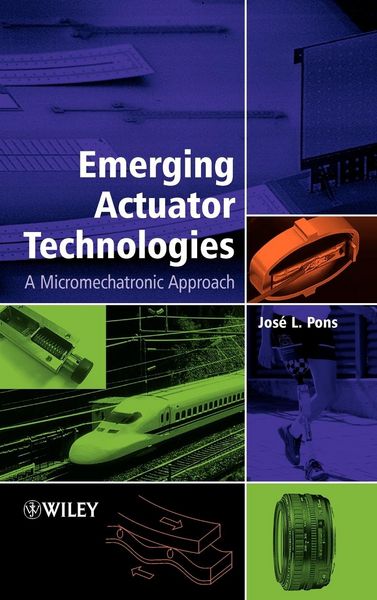
Emerging Actuator Technologies A Micromechatronic Approach
161,99 €
inkl. gesetzl. MwSt.,
Lieferung nach Hause
Beschreibung
Produktdetails
Einband
Gebundene Ausgabe
Erscheinungsdatum
01.05.2005
Verlag
John Wiley & Sons IncSeitenzahl
304
Maße (L/B/H)
23,5/15,7/2,1 cm
Gewicht
539 g
Auflage
1. Auflage
Sprache
Englisch
ISBN
978-0-470-09197-5
Actuators are devices that convert electrical energy into mechanical work, traditionally used in electrical, pneumatic and hydraulic systems. As the demand for actuator technologies grows in biomedical, prosthetic and orthotic applications, there is an increasing need for complex and sophisticated products that perform efficiently also when scaled to micro and nano domains.
Providing a comprehensive overview of actuators for novel applications, this excellent book:
* Presents a mechatronic approach to the design, control and integration of a range of technologies covering piezoelectric actuators, shape memory actuators, electro-active polymers, magnetostrictive actuators and electro- and magnetorheological actuators.
* Examines the characteristics and performance of emerging actuators upon scaling to micro and nano domains.
* Assesses the relative merits of each actuator technology and outlines prospective application fields.
Offering a detailed analysis on current advances in the field, this publication will appeal to practising electrical and electronics engineers developing novel actuator systems. Mechanical and automation engineers, computer scientists and researchers will also find this a useful resource.
Providing a comprehensive overview of actuators for novel applications, this excellent book:
* Presents a mechatronic approach to the design, control and integration of a range of technologies covering piezoelectric actuators, shape memory actuators, electro-active polymers, magnetostrictive actuators and electro- and magnetorheological actuators.
* Examines the characteristics and performance of emerging actuators upon scaling to micro and nano domains.
* Assesses the relative merits of each actuator technology and outlines prospective application fields.
Offering a detailed analysis on current advances in the field, this publication will appeal to practising electrical and electronics engineers developing novel actuator systems. Mechanical and automation engineers, computer scientists and researchers will also find this a useful resource.
Kundinnen und Kunden meinen
Verfassen Sie die erste Bewertung zu diesem Artikel
Helfen Sie anderen Kund*innen durch Ihre Meinung
Kurze Frage zu unserer Seite
Vielen Dank für dein Feedback
Wir nutzen dein Feedback, um unsere Produktseiten zu verbessern. Bitte habe Verständnis, dass wir dir keine Rückmeldung geben können. Falls du Kontakt mit uns aufnehmen möchtest, kannst du dich aber gerne an unseren Kund*innenservice wenden.
zum Kundenservice