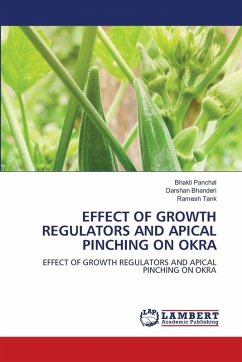
EFFECT OF GROWTH REGULATORS AND APICAL PINCHING ON OKRA
EFFECT OF GROWTH REGULATORS AND APICAL PINCHING ON OKRA
Versandkostenfrei!
Versandfertig in 6-10 Tagen
53,99 €
inkl. MwSt.

PAYBACK Punkte
27 °P sammeln!

Okra [Abelmoschus esculentus (L.) Moench], a member of the Malvaceae family, is an annual fruit vegetable crop and having chromosome no. 2n=130, has captured a prominent position among vegetables. Okra is commonly referred to as Gumbo in the US, lady's finger in the UK, Bhindi in India, and Bhinda in Gujarat. The crop was originated from Tropical Africa and first cultivated by the Egyptians in the 12th AD (Thompson and Kelly, 1979). It is widely grown throughout the world's tropical and subtropical regions. As per recent statistics, India cultivates okra on approximately area of 511 lakh hecta...
Okra [Abelmoschus esculentus (L.) Moench], a member of the Malvaceae family, is an annual fruit vegetable crop and having chromosome no. 2n=130, has captured a prominent position among vegetables. Okra is commonly referred to as Gumbo in the US, lady's finger in the UK, Bhindi in India, and Bhinda in Gujarat. The crop was originated from Tropical Africa and first cultivated by the Egyptians in the 12th AD (Thompson and Kelly, 1979). It is widely grown throughout the world's tropical and subtropical regions. As per recent statistics, India cultivates okra on approximately area of 511 lakh hectares with production 62.5 lakh metric tonnes annually and leading in the world. In India, Gujarat is leading state producing approximately 11.32 lakh metric tonnes in an area of 0.93 lakh hectares okra annually (Anon., 2023). It is popular among vegetable growers throughout India due to adaptability to a wide range of growing conditions. Okra crop requires long warm growing season and is susceptible to frost. The optimum day temperature for its better growth is between 250C to 400C and that of night is over 220C.
Andere Kunden interessierten sich für




![Cover Results of the Growth of Two-rowed Barley From Seed Imported by the Government of Canada [microform]](https://bilder.buecher.de/produkte/65/65561/65561446n.jpg "Results of the Growth of Two-rowed Barley From Seed Imported by the Government of Canada [microform]")