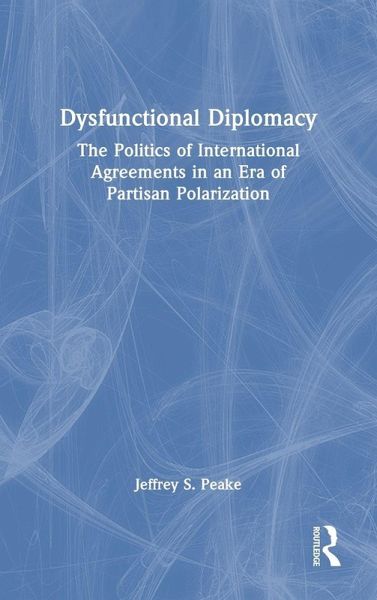
Jeffrey S. Peake
Gebundenes Buch
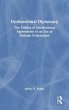
Dysfunctional Diplomacy
The Politics of International Agreements in an Era of Partisan Polarization
Versandkostenfrei!
Versandfertig in 1-2 Wochen
Weitere Ausgaben:
PAYBACK Punkte
79 °P sammeln!
This book assesses the partisan domestic politics that impact international treaties and the unilateral presidential authority that such partisanship encourages.
Jeffrey S. Peake is Professor of Political Science at Clemson University, in Clemson, South Carolina, where he teaches courses on US politics, Congress, and U.S. foreign policy.
Produktdetails
- Verlag: Routledge
- Seitenzahl: 164
- Erscheinungstermin: 30. Dezember 2022
- Englisch
- Abmessung: 235mm x 157mm x 14mm
- Gewicht: 398g
- ISBN-13: 9781032389127
- ISBN-10: 1032389125
- Artikelnr.: 65609761
Herstellerkennzeichnung
Libri GmbH
Europaallee 1
36244 Bad Hersfeld
gpsr@libri.de
Praise for Dysfunctional Diplomacy: The Politics of International Agreements in an Era of Partisan Polarization
Jeffrey Peake usefully demonstrates an important but often overlooked consequence of partisan polarization in Congress: it has rendered the treaty process unworkable. Having no option, presidents rely almost entirely on unilateral tools to make international agreements. This dysfunctional practice has weakened the role of Congress, undermined the country's international commitments, and decreased America's influence on international law.
George C. Edwards III, Texas A&M University and University of Oxford
No one has more thoroughly documented the decline of the U.S. treaty process than Jeffrey Peake. In
Jeffrey Peake usefully demonstrates an important but often overlooked consequence of partisan polarization in Congress: it has rendered the treaty process unworkable. Having no option, presidents rely almost entirely on unilateral tools to make international agreements. This dysfunctional practice has weakened the role of Congress, undermined the country's international commitments, and decreased America's influence on international law.
George C. Edwards III, Texas A&M University and University of Oxford
No one has more thoroughly documented the decline of the U.S. treaty process than Jeffrey Peake. In
Mehr anzeigen
this important book, Peake integrates and extends his groundbreaking empirical work on increasing presidential unilateralism in the making of international agreements. And he shows how this trend undermines the democratic legitimacy of international law and adversely impacts U.S. foreign policy. Both political scientists and international law scholars will learn a great deal from Dysfunctional Diplomacy.
Jack Goldsmith, Harvard University Law School
This is one of the most comprehensive and engaging modern accounts of a "lost art"--the politics of treaty ratification-in an era of deep partisanship and polarization in American politics. The rich data analysis in this book, combined with fascinating case studies of the politics of contemporary treaty ratification and the rise of executive agreements, expose key ingredients in our dysfunctional diplomacy. But they also offer us a way out by exposing critical nodes of resistance and challenge in the process.
Jeffrey S. Lantis, The College of Wooster
Jack Goldsmith, Harvard University Law School
This is one of the most comprehensive and engaging modern accounts of a "lost art"--the politics of treaty ratification-in an era of deep partisanship and polarization in American politics. The rich data analysis in this book, combined with fascinating case studies of the politics of contemporary treaty ratification and the rise of executive agreements, expose key ingredients in our dysfunctional diplomacy. But they also offer us a way out by exposing critical nodes of resistance and challenge in the process.
Jeffrey S. Lantis, The College of Wooster
Schließen
Praise for Dysfunctional Diplomacy: The Politics of International Agreements in an Era of Partisan Polarization
Jeffrey Peake usefully demonstrates an important but often overlooked consequence of partisan polarization in Congress: it has rendered the treaty process unworkable. Having no option, presidents rely almost entirely on unilateral tools to make international agreements. This dysfunctional practice has weakened the role of Congress, undermined the country's international commitments, and decreased America's influence on international law.
George C. Edwards III, Texas A&M University and University of Oxford
No one has more thoroughly documented the decline of the U.S. treaty
Jeffrey Peake usefully demonstrates an important but often overlooked consequence of partisan polarization in Congress: it has rendered the treaty process unworkable. Having no option, presidents rely almost entirely on unilateral tools to make international agreements. This dysfunctional practice has weakened the role of Congress, undermined the country's international commitments, and decreased America's influence on international law.
George C. Edwards III, Texas A&M University and University of Oxford
No one has more thoroughly documented the decline of the U.S. treaty
Mehr anzeigen
process than Jeffrey Peake. In this important book, Peake integrates and extends his groundbreaking empirical work on increasing presidential unilateralism in the making of international agreements. And he shows how this trend undermines the democratic legitimacy of international law and adversely impacts U.S. foreign policy. Both political scientists and international law scholars will learn a great deal from Dysfunctional Diplomacy.
Jack Goldsmith, Harvard University Law School
This is one of the most comprehensive and engaging modern accounts of a "lost art"--the politics of treaty ratification-in an era of deep partisanship and polarization in American politics. The rich data analysis in this book, combined with fascinating case studies of the politics of contemporary treaty ratification and the rise of executive agreements, expose key ingredients in our dysfunctional diplomacy. But they also offer us a way out by exposing critical nodes of resistance and challenge in the process.
Jeffrey S. Lantis, The College of Wooster
Jack Goldsmith, Harvard University Law School
This is one of the most comprehensive and engaging modern accounts of a "lost art"--the politics of treaty ratification-in an era of deep partisanship and polarization in American politics. The rich data analysis in this book, combined with fascinating case studies of the politics of contemporary treaty ratification and the rise of executive agreements, expose key ingredients in our dysfunctional diplomacy. But they also offer us a way out by exposing critical nodes of resistance and challenge in the process.
Jeffrey S. Lantis, The College of Wooster
Schließen
Für dieses Produkt wurde noch keine Bewertung abgegeben. Wir würden uns sehr freuen, wenn du die erste Bewertung schreibst!
Eine Bewertung schreiben
Andere Kunden interessierten sich für