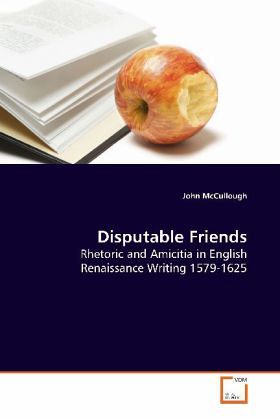
Disputable Friends
Rhetoric and Amicitia in English Renaissance Writing 1579-1625
Versandkostenfrei!
Versandfertig in 6-10 Tagen
52,99 €
inkl. MwSt.

PAYBACK Punkte
26 °P sammeln!

What does it mean to be a friend in Shakespeare''sEngland? In their writings on the subject,Renaissance users of rhetoric would recognize, deployand appreciate tropes and textual ambiguities in amanner alien to twenty-first century readers. Thelarge body of classical writings on friendship whichcropped up on early modern school curricula,especially Cicero s productively paradoxical DeAmicitia, provided imagery and scenarios which couldbe recast by fertile imaginations. This inventive use of tropes and contradictions whenwriting about friendship has important parallels forqueer scholars. The pr...
What does it mean to be a friend in Shakespeare''s
England? In their writings on the subject,
Renaissance users of rhetoric would recognize, deploy
and appreciate tropes and textual ambiguities in a
manner alien to twenty-first century readers. The
large body of classical writings on friendship which
cropped up on early modern school curricula,
especially Cicero s productively paradoxical De
Amicitia, provided imagery and scenarios which could
be recast by fertile imaginations.
This inventive use of tropes and contradictions when
writing about friendship has important parallels for
queer scholars. The problems and benefits of
asserting a queer history are considered here, as
is such a history s ambiguous relationship to
historicist reading practices.
Texts examined include three 1580s conduct books on
friendship; John Florio s translation of Montaigne s
essay on friendship; later English essays on
friendship by Francis Bacon and his contemporaries;
the correspondence between Edmund Spenser and Gabriel
Harvey; and Shakespeare s Hamlet, King Henry IV and
Sonnets.
England? In their writings on the subject,
Renaissance users of rhetoric would recognize, deploy
and appreciate tropes and textual ambiguities in a
manner alien to twenty-first century readers. The
large body of classical writings on friendship which
cropped up on early modern school curricula,
especially Cicero s productively paradoxical De
Amicitia, provided imagery and scenarios which could
be recast by fertile imaginations.
This inventive use of tropes and contradictions when
writing about friendship has important parallels for
queer scholars. The problems and benefits of
asserting a queer history are considered here, as
is such a history s ambiguous relationship to
historicist reading practices.
Texts examined include three 1580s conduct books on
friendship; John Florio s translation of Montaigne s
essay on friendship; later English essays on
friendship by Francis Bacon and his contemporaries;
the correspondence between Edmund Spenser and Gabriel
Harvey; and Shakespeare s Hamlet, King Henry IV and
Sonnets.
Andere Kunden interessierten sich für