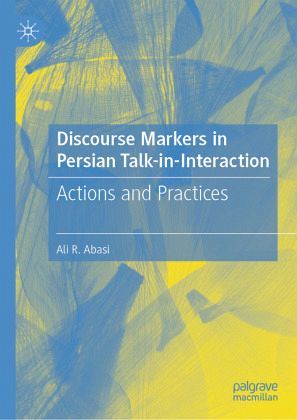
Discourse Markers in Persian Talk-in-Interaction
Actions and Practices
Versandkostenfrei!
Erscheint vorauss. April 2026
98,99 €
inkl. MwSt.

This book describes five ubiquitous discourse markers in Persian talk-in-interaction. It begins with a critical overview of literature on discourse markers and discusses why (neo)Gricean approaches have failed to provide descriptions that are grounded in and demonstrably relevant to how speakers actually use them in interaction, thus limiting their pedagogical value for teaching second language interactional competence.Advocating the adoption of Conversation Analytic methodology (CA) to ground descriptions in empirical data, the book discusses the key fundamental structures of conversation imp...
This book describes five ubiquitous discourse markers in Persian talk-in-interaction. It begins with a critical overview of literature on discourse markers and discusses why (neo)Gricean approaches have failed to provide descriptions that are grounded in and demonstrably relevant to how speakers actually use them in interaction, thus limiting their pedagogical value for teaching second language interactional competence.
Advocating the adoption of Conversation Analytic methodology (CA) to ground descriptions in empirical data, the book discusses the key fundamental structures of conversation implicated in the use of these markers. It then proceeds to describe in detail the interactional work of the five markers in separate chapters.
The book further addresses the challenging task of teaching discourse markers to second language learners. Uniquely, it offers a comprehensive pedagogical model informed by current knowledge about second language acquisition as well as CA descriptions, which can guide teachers and materials developers across all languages. It will be of interest to teachers and language learners (especially of Persian) worldwide, as well as academics and students in the field of Applied Linguistics.
Advocating the adoption of Conversation Analytic methodology (CA) to ground descriptions in empirical data, the book discusses the key fundamental structures of conversation implicated in the use of these markers. It then proceeds to describe in detail the interactional work of the five markers in separate chapters.
The book further addresses the challenging task of teaching discourse markers to second language learners. Uniquely, it offers a comprehensive pedagogical model informed by current knowledge about second language acquisition as well as CA descriptions, which can guide teachers and materials developers across all languages. It will be of interest to teachers and language learners (especially of Persian) worldwide, as well as academics and students in the field of Applied Linguistics.
Andere Kunden interessierten sich für