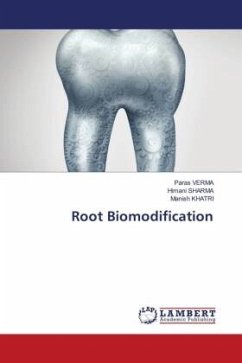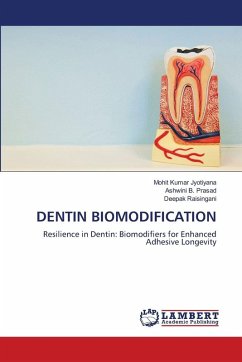
DENTIN BIOMODIFICATION
Resilience in Dentin: Biomodifiers for Enhanced Adhesive Longevity
Versandkostenfrei!
Versandfertig in 6-10 Tagen
53,99 €
inkl. MwSt.

PAYBACK Punkte
27 °P sammeln!

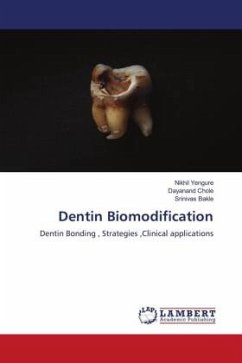
Dentin biomodifier strategies are broadly classified into synthetic and natural . Further these are divided into physical and chemical methods. All of these approaches demonstrate unique mechanisms of interaction with dentin tissue. While originally believed to rely solely on non-enzymatic collagen cross-linking induced by intra- or intermolecular collagen bonding for dentin biomodification. It is now understood that various correlation with other components of dentin are crucial for ensuring biomodification which prolongs the mechanical integrity and biological stability for dentinal bonding....
Dentin biomodifier strategies are broadly classified into synthetic and natural . Further these are divided into physical and chemical methods. All of these approaches demonstrate unique mechanisms of interaction with dentin tissue. While originally believed to rely solely on non-enzymatic collagen cross-linking induced by intra- or intermolecular collagen bonding for dentin biomodification. It is now understood that various correlation with other components of dentin are crucial for ensuring biomodification which prolongs the mechanical integrity and biological stability for dentinal bonding. Oligomeric proanthocyanidins (PAs) demonstrate strong bioactivity however their complex chemical composition requires a thorough analysis of key constituents to develop standardized, sustainable intervention materials prior to progressing to advanced clinical evaluation.
Andere Kunden interessierten sich für