
Death and after?
Exploring the Journey Beyond: Theosophical Perspectives on Death and the Afterlife
Versandkostenfrei!
Versandfertig in 1-2 Wochen
11,50 €
inkl. MwSt.
Weitere Ausgaben:

PAYBACK Punkte
0 °P sammeln!

"Death-and After?" by Annie Besant delves into the theosophical understanding of death and the afterlife, offering a comprehensive exploration of the human constitution and the journey of the soul post-mortem. Besant begins by addressing the common fear and misconceptions surrounding death, particularly within Christian traditions, and contrasts these with the more serene perspectives found in ancient religions and theosophy. She outlines the septenary constitution of man, dividing it into the immortal triad (Atma, Buddhi, Manas) and the perishable quaternary (Kama, Prana, Etheric Double, Dens...
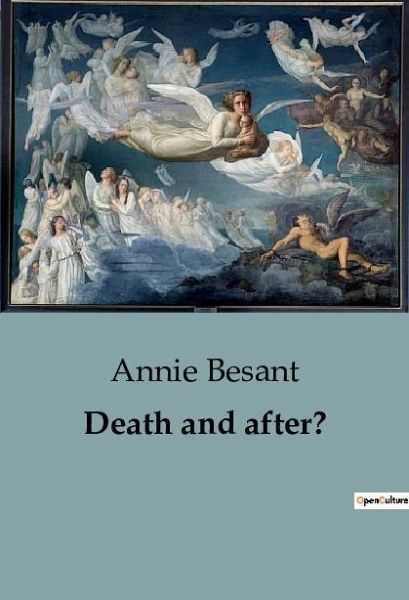
"Death-and After?" by Annie Besant delves into the theosophical understanding of death and the afterlife, offering a comprehensive exploration of the human constitution and the journey of the soul post-mortem. Besant begins by addressing the common fear and misconceptions surrounding death, particularly within Christian traditions, and contrasts these with the more serene perspectives found in ancient religions and theosophy. She outlines the septenary constitution of man, dividing it into the immortal triad (Atma, Buddhi, Manas) and the perishable quaternary (Kama, Prana, Etheric Double, Dense Body). The text explains the process of death as a series of separations, where the soul sheds its physical and etheric bodies, eventually entering Kamaloka, an intermediary state. Here, the soul, still attached to its desires, undergoes a purification process before moving to Devachan, a state of blissful rest. Besant emphasizes the importance of understanding these stages to alleviate the fear of death and to recognize the continuity of consciousness beyond physical existence. She also discusses the potential for communication between the living and the deceased, cautioning against disturbing the natural progression of the soul. The work serves as both a guide and a reassurance, encouraging readers to view death not as an end, but as a passage to a higher state of being.