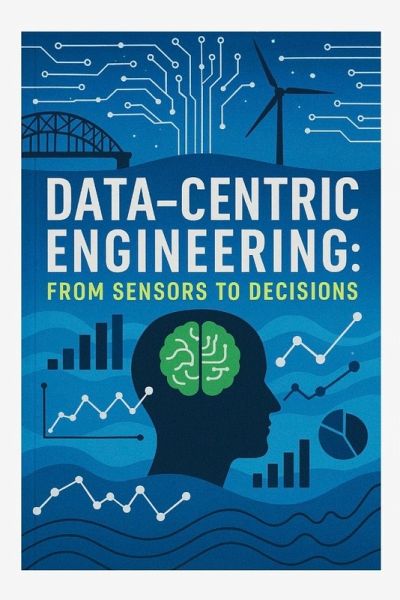
Data-Centric Engineering
From Sensors to Decisions
Versandkostenfrei!
Versandfertig in 1-2 Wochen
27,99 €
inkl. MwSt.

PAYBACK Punkte
14 °P sammeln!

This book explores the transformation of engineering through the integration of data science and machine learning, emphasizing a practical, hands-on approach for students and professionals. It addresses the shift from traditional, intuition-based engineering to a data-centric paradigm, where sensors and digital systems generate vast streams of information that drive innovation, efficiency, and safety. Foundations and Data Characteristics: The text begins by outlining the evolving landscape of engineering data, highlighting the proliferation of sensors in infrastructure, vehicles, and machinery...
This book explores the transformation of engineering through the integration of data science and machine learning, emphasizing a practical, hands-on approach for students and professionals. It addresses the shift from traditional, intuition-based engineering to a data-centric paradigm, where sensors and digital systems generate vast streams of information that drive innovation, efficiency, and safety. Foundations and Data Characteristics: The text begins by outlining the evolving landscape of engineering data, highlighting the proliferation of sensors in infrastructure, vehicles, and machinery. It discusses the unique challenges of engineering data, such as its temporal and spatial nature, heterogeneity, multimodality, noise, uncertainty, missing values, and the sheer scale and volume encountered in real-world applications. Signal Processing and Feature Engineering: A core focus is on transforming raw sensor data into actionable insights. The book details foundational signal processing techniques (time and frequency domain analysis, filtering, wavelet transforms) and the importance of feature engineering-extracting meaningful variables that capture system behavior. It covers statistical, temporal, frequency-based, and domain-specific features, emphasizing their role in improving model performance and interpretability1. Data Quality, Pipelines, and Labeling: Ensuring data quality is presented as a critical engineering discipline. The book covers strategies for outlier detection, handling missing data, validation, and monitoring. It also addresses the art of data labeling, discussing labeling strategies, tools, quality control, and the challenges of annotating complex engineering datasets. Building Production-Ready ML Pipelines: The text provides a comprehensive guide to designing robust, scalable, and maintainable machine learning pipelines. It covers data ingestion, real-time vs. batch processing, automated cleaning, feature engineering, model training, evaluation, deployment (batch, real-time, edge), and continuous monitoring for drift and performance degradation. Emphasis is placed on reproducibility, version control, and the use of MLOps practices1. Case Studies and Advanced Topics: Practical case studies, such as structural health monitoring, illustrate the end-to-end application of these concepts. Advanced topics include explainable AI, reinforcement learning, federated learning, simulation, and digital twins-showing how AI augments engineering decision-making and system optimization. Best Practices and Cultural Shift: The book concludes by advocating for a data-driven engineering culture, ethical considerations, continuous learning, and thorough documentation. It encourages engineers to embrace data as a strategic asset, fostering collaboration between domain experts and data scientists to drive innovation and ensure the reliability and safety of engineered systems.
Andere Kunden interessierten sich für