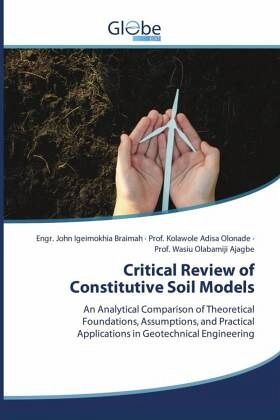
Critical Review of Constitutive Soil Models
An Analytical Comparison of Theoretical Foundations, Assumptions, and Practical Applications in Geotechnical Engineering
Versandkostenfrei!
Versandfertig in 6-10 Tagen
29,99 €
inkl. MwSt.

PAYBACK Punkte
15 °P sammeln!

This paper presents a comprehensive and comparative review of key soil constitutive models commonly used in geotechnical engineering, including the Mohr-Coulomb, Cam Clay, Modified Cam Clay, Drucker-Prager, and Duncan-Chang models. These models are evaluated based on their mathematical foundations, assumptions, strengths, limitations, and practical applications in predicting soil behavior under various loading conditions. The study highlights the gap between theoretical modeling and real-world soil responses, especially in handling complex behaviors such as cyclic loading, anisotropy, and post...
This paper presents a comprehensive and comparative review of key soil constitutive models commonly used in geotechnical engineering, including the Mohr-Coulomb, Cam Clay, Modified Cam Clay, Drucker-Prager, and Duncan-Chang models. These models are evaluated based on their mathematical foundations, assumptions, strengths, limitations, and practical applications in predicting soil behavior under various loading conditions. The study highlights the gap between theoretical modeling and real-world soil responses, especially in handling complex behaviors such as cyclic loading, anisotropy, and post-peak softening. While traditional models like Mohr-Coulomb remain useful for quick failure predictions, advanced models such as Modified Cam Clay and Duncan-Chang provide more realistic simulations for clays and granular soils, respectively. Through side-by-side comparisons and analysis, this review aims to guide engineers and researchers in choosing the most appropriate model for various challenges involving the soil as a whole. The work also emphasizes the need for improved models that can incorporate time-dependent behavior, field calibration, and modern data-driven methods.
Andere Kunden interessierten sich für