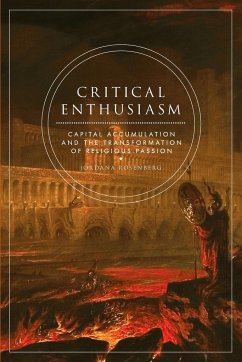
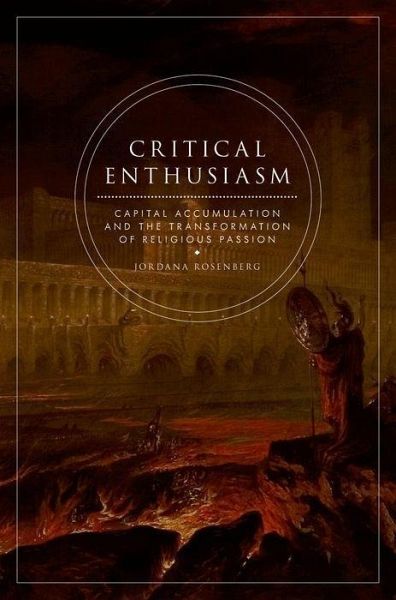
Critical Enthusiasm
Capital Accumulation and the Transformation of Religious Passion
Versandkostenfrei!
Versandfertig in 1-2 Wochen
129,99 €
inkl. MwSt.
Weitere Ausgaben:

PAYBACK Punkte
65 °P sammeln!

Critical Enthusiasm concerns itself with two major, interrelated phenomena of the long eighteenth century: the onset of capital accumulation and the loosening of religious discourse to describe intellectual, aesthetic, and ethical experiences. Through this unusual pairing, Critical Enthusiasm shows that debates around religious radicalism are bound to the advent of capitalism at its very root: as legal precedent, as financial rhetoric, and as aesthetic form. As a result, we must contextualize the histories of religion and secularization in terms of the economic landscape of early modernity. Critical Enthusiasm contributes to new directions of scholarship in literary and legal history, secularization studies, and economic criticism. It is unique among other such projects, given that it produces a model for literary study that is simultaneously attuned to the history of capital accumulation and to the forces of religious dissent. Adopting a comparative, transatlantic approach, Critical Enthusiasm situates the rhetoric of enthusiastic rapture in the context of the major institutional transformations of early modernity - transformation that now drive our contemporary world order: the dispossession and plunder of the globe, the rise of finance, legal reform, and the administration of racialized labor. By approaching the history of capitalism through religious debates, Critical Enthusiasm discloses legacies of aesthetic form and of global flows of capital that have been hitherto inaccessible to our study of the period. Chapters bring together the moral philosophy of the Third Earl of Shaftesbury, French Camisard religious prophesy, early modern statute law, Swift's poetry, and the political theory of Hobbes, Hume, and Locke.
The Atlantic world of the long eighteenth century was characterized by two major, interrelated phenomena: the onset of capital accumulation and the infusion of traditions of radical religious rapture into Enlightenment discourses. In exploring these cross-pollinations, Critical Enthusiasm shows that debates around religious radicalism are bound to the advent of capitalism at its very root: as legal precedent, as financial rhetoric, and as aesthetic form. To understand the period thus requires that we not only contextualize histories of religion in terms of the economic landscape of early modernity, but also recast the question of secularization in terms of the contradictions of capitalism. Critical Enthusiasm contributes to new directions of scholarship in literary and legal history, secularization studies, and economic criticism. It is unique in producing a model for literary and cultural study that is simultaneously attuned to economic and religious forces. By approaching the history of capitalism through religious debates, Critical Enthusiasm discloses significant intersections of aesthetic form and of financial flows that have been hitherto ignored. Through chapters that highlight moral philosophy, religious prophesy, early modern statute law, poetry, and political theory, Rosenberg shows that the contested nature of enthusiastic rapture is crucial to understanding the major institutional transformations of early modernity. These transformations--colonial plunder, the rise of finance, the administration of racialized labor, and the legal reform that justified such practices--shaped the period; they also laid the foundation for our contemporary world.
Andere Kunden interessierten sich für