Gutscheinbedingungen

**Gültig bis 10.06.2026 / Gültig für gebrauchte Bücher / Mindestbestellwert 20,00 € / Einzelne Artikel können ausgeschlossen sein / Online auf www.bücher.de.de / Nicht kombinierbar mit anderen Gutscheinen oder Preisaktionen / Nur einmal pro Einkauf einlösbar / Gutschein wird auf max. 500€ Bestellwert angerechnet / Keine Barauszahlung / Nicht gültig für Versandkosten und Services

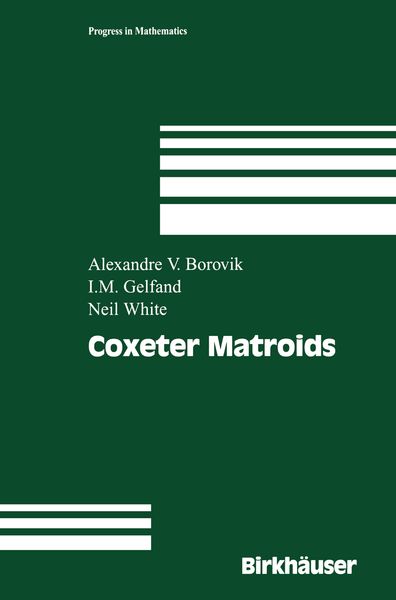
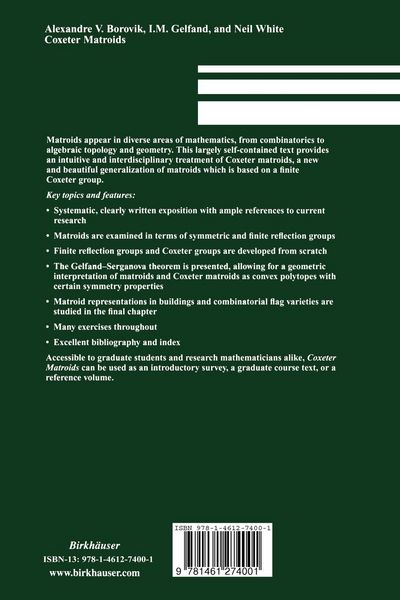
  • Produktbild: Coxeter Matroids
  • Produktbild: Coxeter Matroids
Band 216

Coxeter Matroids

Aus der Reihe Progress in Mathematics

49,99 €

inkl. gesetzl. MwSt., Versandkostenfrei

Lieferung nach Hause

Beschreibung

Produktdetails

Einband

Taschenbuch

Erscheinungsdatum

16.09.2011

Illustriert von

A. Borovik

Verlag

Birkhäuser Boston

Seitenzahl

266

Maße (L/B/H)

23,5/15,5/1,6 cm

Gewicht

452 g

Auflage

2003

Sprache

Englisch

ISBN

978-1-4612-7400-1

Beschreibung

Rezension

From the reviews:


"This largely self-contained text provides an intuitive and interdisciplinary treatment of Coxeter matroids, a new and beautiful generalization of matroids which is based on a finite Coxeter group."


— ZENTRALBLATT MATH


"...this accessible and well-written book, intended to be "a cross between a postgraduate text and a research monograph," is well worth reading and makes a good case for doing matroids with mirrors."


— SIAM REVIEW


"This accessible and well-written book, intended to be ‘a cross between a postgraduate text and a research monograph,’ is well worth reading and makes a good case for doing matroids with mirrors." (Joseph Kung, SIAM Review, Vol. 46 (3), 2004)


"This accessible and well-written book, designed to be ‘a cross between a postgraduate text and a research monograph’, should win many converts.”(MATHEMATICAL REVIEWS)

Produktdetails

Einband

Taschenbuch

Erscheinungsdatum

16.09.2011

Illustriert von

A. Borovik

Verlag

Birkhäuser Boston

Seitenzahl

266

Maße (L/B/H)

23,5/15,5/1,6 cm

Gewicht

452 g

Auflage

2003

Sprache

Englisch

ISBN

978-1-4612-7400-1

Herstelleradresse

Springer-Verlag GmbH
Tiergartenstr. 17
69121 Heidelberg
DE

Email: ProductSafety@springernature.com

Kundinnen und Kunden meinen

0 Bewertungen

Informationen zu Bewertungen

Zur Abgabe einer Bewertung ist eine Anmeldung im Konto notwendig. Die Authentizität der Bewertungen wird von uns nicht überprüft. Wir behalten uns vor, Bewertungstexte, die unseren Richtlinien widersprechen, entsprechend zu kürzen oder zu löschen.

Die Bewertungen sind nach Format, Anzahl Sterne und Datum sortiert.

Verfassen Sie die erste Bewertung zu diesem Artikel

Helfen Sie anderen Kund*innen durch Ihre Meinung

Kundinnen und Kunden meinen

0 Bewertungen filtern

  • Produktbild: Coxeter Matroids
  • Produktbild: Coxeter Matroids
  • 1 Matroids and Flag Matroids.- 1.1 Matroids.- 1.1.1 Definition in terms of bases.- 1.1.2 Examples.- 1.1.3 Circuits.- 1.2 Representable matroids.- 1.3 Maximality Property.- 1.4 Increasing Exchange Property.- 1.5 Sufficient systems of exchanges.- 1.5.1 Strong Exchange Property.- 1.6 Matroids as maps.- 1.7 Flag matroids.- 1.7.1 Flags.- 1.7.2 Flag matroids.- 1.7.3 Matroid quotients.- 1.7.4 Equivalence of Maximality Property and concordance of constituents.- 1.7.5 Representable flag matroids.- 1.7.6 Higgs lift.- 1.8 Flag matroids as maps.- 1.9 Exchange properties for flag matroids.- 1.9.1 Increasing Exchange Property for flag matroids.- 1.9.2 Failure of the Strong Exchange Property for flag matroids.- 1.10 Root system.- 1.10.1 Roots.- 1.10.2 Transpositions and reflections.- 1.10.3 Geometric representation of flags.- 1.10.4 Orderings associated with the root system.- 1.11 Polytopes associated with flag matroids.- 1.11.1 Polytopes associated with flag matroids.- 1.11.2 Main Theorem.- 1.12 Properties of matroid polytopes.- 1.12.1 Adjacency in matroids.- 1.12.2 Groups generated by transpositions.- 1.12.3 Components of matroids and the transposition graph.- 1.12.4 2-dimensional faces of matroid polytopes.- 1.12.5 Dimension of the matroid polytope.- 1.13 Minkowski sums.- 1.14 Exercises for Chapter 1.- 2 Matroids and Semimodular Lattices.- 2.1 Lattices as generalizations of projective geometry.- 2.2 Semimodular lattices.- 2.3 Jordan—Hölder permutation.- 2.4 Geometric lattices.- 2.4.1 Bases of lattices.- 2.4.2 Closure operators.- 2.4.3 Geometric lattice determined by a matroid.- 2.5 Representations of matroids.- 2.6 Representation of flag matroids.- 2.6.1 Retractions.- 2.6.2 Matroid maps from chains.- 2.7 Every flag matroid is representable.- 2.8 Exercises for Chapter 2.- 3 Symplectic Matroids.- 3.1 Definition of symplectic matroids.- 3.1.1 Hyperoctahedral group and admissible permutations.- 3.1.2 Admissible orderings.- 3.1.3 Symplectic matroids.- 3.2 Root systems of type Cn.- 3.2.1 Roots.- 3.2.2 Simple systems of roots.- 3.2.3 Correspondences.- 3.3 Polytopes associated with symplectic matroids.- 3.3.1 Geometric representation of admissible sets.- 3.3.2 Gelfand—Serganova Theorem for symplectic matroids.- 3.4 Representable symplectic matroids.- 3.4.1 Isotropic subspaces.- 3.4.2 Symplectic matroids from isotropic subspaces.- 3.4.3 Examples.- 3.4.4 Operations on representations.- 3.5 Homogeneous symplectic matroids.- 3.6 Symplectic flag matroids.- 3.6.1 Examples.- 3.6.2 Representable symplectic flag matroids.- 3.7 Greedy Algorithm.- 3.8 Independent sets.- 3.9 Symplectic matroid constructions.- 3.10 Orthogonal matroids.- 3.10.1 Dn-admissible orderings.- 3.10.2 Orthogonal matroids.- 3.10.3 Representable orthogonal matroids.- 3.10.4 Orthogonal flag matroids.- 3.11 Open problems.- 3.12 Exercises for Chapter 3.- 4 Lagrangian Matroids.- 4.1 Lagrangian matroids.- 4.1.1 Transversals.- 4.1.2 Symmetric Exchange Axiom.- 4.1.3 Represented Lagrangian matroids.- 4.1.4 Homogeneous Lagrangian matroids.- 4.2 Circuits and strong exchange.- 4.2.1 Dual matroid.- 4.2.2 Circuits.- 4.2.3 Circuits and cocircuits.- 4.2.4 Strong Exchange Property.- 4.2.5 Circuit characterizations of Lagrangian matroids.- 4.3 Maps on orientable surfaces.- 4.3.1 Maps on compact surfaces.- 4.3.2 Matroids, representations and maps.- 4.4 Exercises for Chapter 4.- 5 Reflection Groups and Coxeter Groups.- 5.1 Hyperplane arrangements.- 5.1.1 Chambers of a hyperplane arrangement.- 5.1.2 Galleries.- 5.2 Polyhedra and polytopes.- 5.3 Mirrors and reflections.- 5.3.1 Systems of mirrors and of reflections.- 5.3.2 Finite reflection groups.- 5.4 Root systems.- 5.4.1 Mirrors and their normal vectors.- 5.4.2 Root systems.- 5.4.3 Positive and simple systems.- 5.4.4 Classification of root systems.- 5.5 Isotropy groups.- 5.6 Parabolic subgroups.- 5.7 Coxeter complex.- 5.7.1 Chambers.- 5.7.2 Generation by simple reflections.- 5.7.3 Action of W on W.- 5.8 Labeling of the Coxeter complex.- 5.9 Galleries.- 5.9.1 Bending.- 5.10 Generators and relations.- 5.10.1 Coxeter group.- 5.11 Convexity.- 5.12 Residues.- 5.12.1 The mirror system of a residue.- 5.12.2 Residues are convex.- 5.12.3 Gate property of residues.- 5.12.4 Opposite chamber in a residue.- 5.13 Foldings.- 5.14 Bruhat order.- 5.14.1 Characterization of the Bruhat order.- 5.14.2 Bruhat ordering on W / WJ.- 5.15 Splitting the Bruhat order.- 5.15.1 Some properties of the length function l(w).- 5.15.2 The property Z.- 5.16 Generalized permutahedra.- 5.17 Symmetric group as a Coxeter group.- 5.17.1 Coxeter complex of the symmetric group.- 5.17.2 Permutahedron.- 5.17.3 Length in Symn.- 5.17.4 Bruhat order in Symn.- 5.18 Exercises for Chapter 5.- 6 Coxeter Matroids.- 6.1 Coxeter matroids.- 6.1.1 The Maximality Property.- 6.1.2 Matroid maps.- 6.1.3 Flag matroids are Coxeter matroids.- 6.1.4 The Strong Exchange Property.- 6.1.5 The Increasing Exchange Property.- 6.2 Root systems.- 6.2.1 Orbits of W on V.- 6.2.2 Orderings of W · ?J.- 6.3 The Gelfand—Serganova Theorem.- 6.3.1 A Useful reformulation of the Gelfand—Serganova Theorem.- 6.3.2 A corollary.- 6.4 Coxeter matroids and polytopes.- 6.5 Examples.- 6.6 W-matroids.- 6.7 Characterization of matroid maps.- 6.8 Adjacency in matroid polytopes.- 6.9 Combinatorial adjacency.- 6.10 The matroid polytope.- 6.11 Exchange groups of Coxeter matroids.- 6.11.1 Dimension of the matroid polytope.- 6.12 Flag matroids and concordance.- 6.12.1 Shifts.- 6.12.2 Concordance.- 6.12.3 Constituents of a flag matroid.- 6.13 Combinatorial flag variety.- 6.13.1 Definition of the combinatorial flag variety.- 6.13.2 Weak map ordering.- 6.13.3 Expansion.- 6.14 Shellable simplicial complexes.- 6.15 Shellability of the combinatorial flag variety.- 6.16 Open problems.- 6.17 Exercises for Chapter 6.- 7 Buildings.- 7.1 Gaussian decomposition.- 7.2 BN-pairs.- 7.2.1 Definition of a BN-pair.- 7.2.2 Standard generators are involutions.- 7.2.3 Length function.- 7.2.4 Bruhat decomposition.- 7.2.5 Refinement of Axiom BN1.- 7.3 Deletion Property.- 7.4 Deletion property and Coxeter groups.- 7.5 Reflection representation of W.- 7.5.1 Construction.- 7.5.2 The Coxeter graph.- 7.5.3 Irreducibility of the reflection representation.- 7.5.4 Finite Coxeter groups are Euclidean reflection groups.- 7.5.5 Positive and negative roots.- 7.5.6 The reflection representation is faithful.- 7.6 Classification of finite Coxeter groups.- 7.6.1 Labeled graphs and associated bilinear forms.- 7.6.2 Classification of positive definite graphs.- 7.7 Chamber systems.- 7.7.1 Chamber systems.- 7.7.2 Coxeter complex.- 7.7.3 Residues and parabolic subgroups.- 7.7.4 The geometric realization.- 7.7.5 Flag complex of a vector space.- 7.8 W-metric.- 7.8.1 W-metrics and associated chamber systems.- 7.8.2 Order complex of a sermmodular lattice admits a W-metric.- 7.9 Buildings.- 7.9.1 Definition of buildings.- 7.9.2 Generalized m-gons.- 7.9.3 Buildings of projective spaces.- 7.9.4 Building associated with a BN-pair.- 7.9.5 Strongly transitive automorphism groups.- 7.10 Representing Coxeter matroids in buildings.- 7.10.1 Retractions.- 7.10.2 Apartments are convex.- 7.10.3 Geodesic galleries and reduced words.- 7.10.4 Retractions give matroid maps.- 7.11 Vector-space representations and building representations.- 7.11.1 An, Bn, Cn and Dn-representations.- 7.11.2 Buildings from flags of subspaces.- 7.11.3 Vector-space representations of W-matroids are building representations.- 7.12 Residues in buildings.- 7.12.1 Residues are convex.- 7.12.2 Residues are buildings.- 7.12.3 Intersection of residues.- 7.12.4 Intersection of a residue and an apartment.- 7.13 Buildings of type An-1 = Symn.- 7.14 Combinatorial flag varieties, revisited.- 7.14.1 Gaussian schemes.- 7.14.2 Retractions.- 7.14.3 Representation morphism.- 7.14.4 Partial metric on ?W*.- 7.14.5 The case W = An-1.- 7.15 Open Problems.- 7.16 Exercises for Chapter 7.- References.