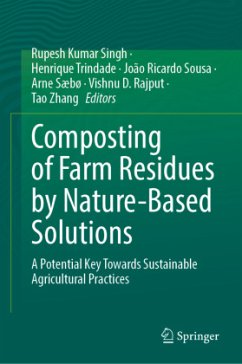
Composting of Farm Residues by Nature-Based Solutions
A Potential Key Towards Sustainable Agricultural Practices
Herausgegeben: Singh, Rupesh Kumar; Trindade, Henrique; Sousa, João Ricardo; Sæbø, Arne; Rajput, Vishnu D.; Zhang, Tao
Versandkostenfrei!
Erscheint vorauss. April 2026
151,99 €
inkl. MwSt.

Sustainable management of organic residues dragged attention to develop model circular based economy in agriculture. Exponential increase in animal farming to meet the food security goals appeared as one of the major contributors of organic waste produce. Sustainable and effective transformation of this waste into fertilization resource, has become an urgent topic for environmental protection; while newly imposed regulations have been enforcing the researchers to obtain nature-based solutions (NBS). Major problems during composting of organic residues are Greenhous gas emission (GHG), nutrient...
Sustainable management of organic residues dragged attention to develop model circular based economy in agriculture. Exponential increase in animal farming to meet the food security goals appeared as one of the major contributors of organic waste produce. Sustainable and effective transformation of this waste into fertilization resource, has become an urgent topic for environmental protection; while newly imposed regulations have been enforcing the researchers to obtain nature-based solutions (NBS). Major problems during composting of organic residues are Greenhous gas emission (GHG), nutrient loss, ammonia volatilization, denitrification, nitrate leaching: thus, poor quality manures production. Thus, it is necessary to understand the mechanism during the composting process to develop sustainable composting practices by using NBS; to address multiple issues by a unique treatment method.
The future of agriculture must change to adapt more sustainable approaches and recycling the organic residues to minimize the environmental impacts. Application of these transformed organic residues to soil to improve the soil natural properties and enrich the natural microbiome. The better crop performance and improved environmental health in a holistic approach is major objective. The past decade provided innovations and new technologies on the impact and use of organic composts in fields with tremendous outcomes. This book provides a wider and recent literature on evolution, multiple nature-based solutions, reduced environmental hazards and better management of organic waste produce towards transformation into usable manure for value added services. This compilation may provide a basis of further investigation of this potential key to achieve the sustainable management practices in modern agriculture.
The future of agriculture must change to adapt more sustainable approaches and recycling the organic residues to minimize the environmental impacts. Application of these transformed organic residues to soil to improve the soil natural properties and enrich the natural microbiome. The better crop performance and improved environmental health in a holistic approach is major objective. The past decade provided innovations and new technologies on the impact and use of organic composts in fields with tremendous outcomes. This book provides a wider and recent literature on evolution, multiple nature-based solutions, reduced environmental hazards and better management of organic waste produce towards transformation into usable manure for value added services. This compilation may provide a basis of further investigation of this potential key to achieve the sustainable management practices in modern agriculture.
Andere Kunden interessierten sich für