• Produktbild: Comparing Voting Systems
  • Produktbild: Comparing Voting Systems
Band 3 - 12%

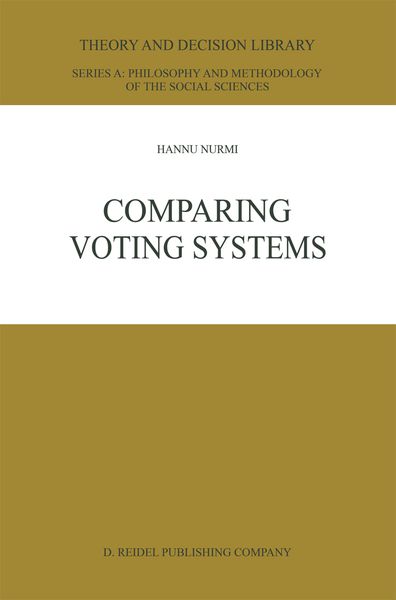
Comparing Voting Systems

12% sparen

93,99 € UVP 106,99 €

inkl. gesetzl. MwSt., Versandkostenfrei

Lieferung nach Hause

Beschreibung

Produktdetails

Einband

Taschenbuch

Erscheinungsdatum

01.10.2011

Verlag

Springer Netherland

Seitenzahl

209

Maße (L/B/H)

23,5/15,5/1,3 cm

Auflage

Softcover reprint of the original 1st ed. 1987

Sprache

Englisch

ISBN

978-94-010-8268-6

Beschreibung

Produktdetails

Einband

Taschenbuch

Erscheinungsdatum

01.10.2011

Verlag

Springer Netherland

Seitenzahl

209

Maße (L/B/H)

23,5/15,5/1,3 cm

Auflage

Softcover reprint of the original 1st ed. 1987

Sprache

Englisch

ISBN

978-94-010-8268-6

Herstelleradresse

Springer-Verlag GmbH
Tiergartenstr. 17
69121 Heidelberg
DE

Email: ProductSafety@springernature.com

Kundinnen und Kunden meinen

0 Bewertungen

Informationen zu Bewertungen

Zur Abgabe einer Bewertung ist eine Anmeldung im Konto notwendig. Die Authentizität der Bewertungen wird von uns nicht überprüft. Wir behalten uns vor, Bewertungstexte, die unseren Richtlinien widersprechen, entsprechend zu kürzen oder zu löschen.

Die Bewertungen sind nach Format, Anzahl Sterne und Datum sortiert.

Verfassen Sie die erste Bewertung zu diesem Artikel

Helfen Sie anderen Kund*innen durch Ihre Meinung

Kundinnen und Kunden meinen

0 Bewertungen filtern

  • Produktbild: Comparing Voting Systems
  • Produktbild: Comparing Voting Systems
  • 1. Introduction.- 2. Preliminaries.- 3. Social Welfare Function, Social Choice Function and Voting Procedures.- 4. First Problem: Cyclic Majorities.- 4.1. The Condorcet paradox.- 4.2. How to conceal the problem: the amendment procedure.- 4.3. How common are the cycles.- 4.4. Solutions based on ordinal preferences.- 4.4.1. Schwartz’ procedure.- 4.4.2. Dodgson’s procedure.- 4.4.3. The maximin method.- 4.5. Solution based on scoring function: the Borda count.- 4.6. More general majority cycles.- 5. Second Problem: How to Satisfy the Condorcet Criteria.- 5.1. Condorcet criteria.- 5.2. Some complete successes.- 5.3. Some partial successes.- 5.4. Complete failures.- 5.5. Some probability considerations and the plausibility of the Condorcet criteria.- 5.6. The majority winning criterion.- 6. Third Problem: How the Avoid Perverse Response to Changes in Individual Opinions.- 6.1. Monotonicity and related concepts.- 6.2. Successes.- 6.3. Failures.- 6.4. The relevance of the monotonicity criteria.- 7. Fourth Problem: How to Honour Unanimous Preferences.- 7.1. Unanimity and Pareto conditions.- 7.2. Successes.- 7.3. A partial failure and a total failure.- 7.4 Relevance and compatibility with other criteria.- 8. Fifth Problem: How to Make Consistent Choices.- 8.1. Choice set invariance criteria.- 8.2. Performances with respect to consistency.- 8.3. Performances with respect to WARP and PI.- 8.4. The relevance of the criteria.- 9. Sixth Problem: How to Encourage the Sincere Revelation of Preferences.- 9.1. Manipulability.- 9.2. Performance with respect to manipulability.- 9.3. The difficulty of manipulation.- 9.4. Agenda-manipulability.- 9.5. Sincere truncation of preferences.- 10. Social Choice Methods Based on More detailed information about Individual Preferences.- 10.1. The von Neumann-Morgenstern utility and classes of interpersonal comparability.- 10.2. Old and new methods.- 10.3. An assessment.- 11. Asking for Less Than Individual Preference Orderings.- 11.1. Constructing a social preference order for a subset of alternatives.- 11.2. Results based on individual choice functions.- 12. Why Is There So Much Stability and How Can We Get More of It?.- 12.1. Explanations of stability.- 12.2. Improving the performance of the voting procedures.- 13. From Committees to Elections.- 13.1. Proportional and majoritarian systems.- 13.2. Criteria for proportional systems.- 13.3. Voting power.- 14. Conclusions.- Name Index.