
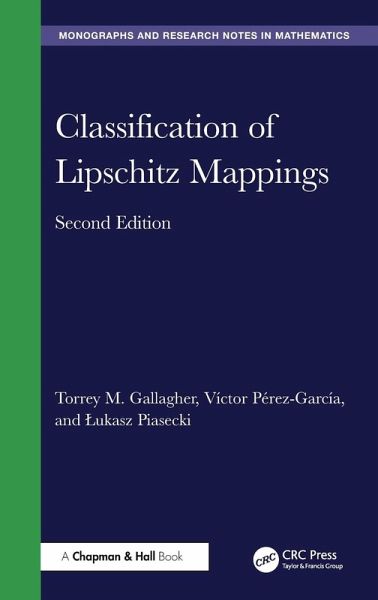
Classification of Lipschitz Mappings
Versandkostenfrei!
Versandfertig in 1-2 Wochen
207,99 €
inkl. MwSt.
Weitere Ausgaben:

PAYBACK Punkte
104 °P sammeln!

Classification of Lipschitz Mappings, Second Edition presents a systematic, self-contained treatment of a new classification of Lipschitz mappings and its applications, particularly to metric fixed point theory. Suitable for readers interested in nonlinear analysis, metric fixed point theory, differential equations, ergodic theory, and dynamical systems, the book requires only a basic background in functional analysis and topology, and should therefore be accessible to graduate students or advanced undergraduates, as well as to professionals looking for new topics in metric fixed point theory....
Classification of Lipschitz Mappings, Second Edition presents a systematic, self-contained treatment of a new classification of Lipschitz mappings and its applications, particularly to metric fixed point theory. Suitable for readers interested in nonlinear analysis, metric fixed point theory, differential equations, ergodic theory, and dynamical systems, the book requires only a basic background in functional analysis and topology, and should therefore be accessible to graduate students or advanced undergraduates, as well as to professionals looking for new topics in metric fixed point theory.
In particular, the second edition contains results related to:
Regulating the growth of the sequence of Lipschitz constants k(Tn)Ensuring good estimates for k0(T) and k (T)Studying moving harmonic and geometric averages as well as generalized Fibonacci-type sequences and their application to provide a new algorithm for solving polynomials in the real case and in Banach algebrasClassifying mean isometries and mean contractionsGeneralizing Browder's famous Demiclosedness PrincipleProviding some new results in metric fixed point theoryMinimal displacement and optimal retraction problems
In particular, the second edition contains results related to:
Regulating the growth of the sequence of Lipschitz constants k(Tn)Ensuring good estimates for k0(T) and k (T)Studying moving harmonic and geometric averages as well as generalized Fibonacci-type sequences and their application to provide a new algorithm for solving polynomials in the real case and in Banach algebrasClassifying mean isometries and mean contractionsGeneralizing Browder's famous Demiclosedness PrincipleProviding some new results in metric fixed point theoryMinimal displacement and optimal retraction problems
Andere Kunden interessierten sich für