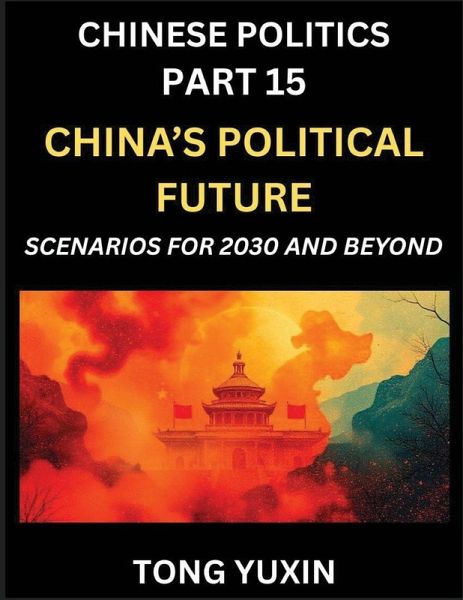
Chinese Politics (Part 15)- China's Political Future, Scenarios for 2030 and Beyond, Demographic, Technological, and Global Pathways in an Age of Disruption and the New Global Order
Principles and Progress
Versandkostenfrei!
Versandfertig in 1-2 Wochen
48,99 €
inkl. MwSt.

PAYBACK Punkte
24 °P sammeln!

China's political future is being rewritten by a confluence of forces that are reshaping its society, economy, and place in the world. By 2030, the nation will face a demographic crisis unlike any before-a shrinking workforce, an aging population, and the long shadow of the one-child policy (¿¿¿¿¿¿ dúsh¿ngn¿z¿ zhèngcè)-all while striving to maintain economic growth and social stability. At the same time, technological breakthroughs (¿¿¿¿ k¿jì f¿iyuè), from artificial intelligence to quantum computing, are empowering the state with unprecedented tools for surveillance and co...
China's political future is being rewritten by a confluence of forces that are reshaping its society, economy, and place in the world. By 2030, the nation will face a demographic crisis unlike any before-a shrinking workforce, an aging population, and the long shadow of the one-child policy (¿¿¿¿¿¿ dúsh¿ngn¿z¿ zhèngcè)-all while striving to maintain economic growth and social stability. At the same time, technological breakthroughs (¿¿¿¿ k¿jì f¿iyuè), from artificial intelligence to quantum computing, are empowering the state with unprecedented tools for surveillance and control, fueling debates over the future of governance: Will China lean into techno-authoritarianism (¿¿¿¿¿¿ jìshù w¿iquánzh¿yì), or find a way to balance innovation with political openness?Globally, China's ambitions are colliding with a new world order (¿¿¿¿¿ x¿n quánqiú zhìxù) defined by great-power rivalry, climate crises, and shifting alliances. The Belt and Road Initiative (¿¿¿¿ Y¿dài Y¿lù) is reshaping trade routes, while competition over critical technologies (¿¿¿¿ günjiàn jìshù)-5G, semiconductors, green energy-is becoming a battleground for supremacy. Domestically, the Communist Party (¿¿¿¿¿ Zh¿ngguó Gòngch¿nd¿ng) faces a delicate balancing act: sustaining legitimacy amid rising expectations, managing regional disparities, and preventing social unrest in an era of rapid urbanization and digital activism.This book does not offer a single prophecy but instead lays out multiple plausible futures (¿¿¿¿ düzhòng wèilái) for China. One path envisions a "resilient authoritarian" state, using technology to tighten control while navigating economic slowdowns. Another imagines a "techno-democratic" China, where limited political reforms coexist with cutting-edge innovation. A third scenario warns of fragmentation (¿¿ f¿nhuà), as regional tensions and inequality¿¿ (s¿liè, tear apart) the nation. Finally, there is the audacious possibility of China emerging as a global hegemon (¿¿¿¿ quánqiú bàquán), reshaping international norms through economic clout and military modernization.Each trajectory hinges on critical variables: domestic cohesion (¿¿¿¿¿ guónèi níngjùlì) in the face of demographic stress, global acceptance (¿¿¿¿ guójì rènk¿) of China's rising influence, and the government's ability to adapt governance models (¿¿¿¿¿ shìyìngxìng zhìl¿) to an era of disruption. The choices China makes-and the reactions of its rivals-will define not just its own future, but the 21st-century global order (21¿¿¿¿¿¿ 21 shìjì shìjiè zhìxù).This is not a story of inevitable decline or triumph. It is a map of possibility (¿¿¿ k¿néngxìng), urging readers to consider how China's evolution will ripple across the world. The stakes could not be higher: for Beijing, the challenge is to redefine what it means to be a global power (¿¿¿¿ quánqiú dàguó) in an age where old rules no longer apply.
Andere Kunden interessierten sich für