Chemical Potential
Versandkostenfrei!
Versandfertig in 6-10 Tagen
32,99 €
inkl. MwSt.

PAYBACK Punkte
16 °P sammeln!

High Quality Content by WIKIPEDIA articles! Chemical potential, symbolized by , is a quantity first described by the American engineer, chemist and mathematical physicist Josiah Williard Gibbs. He defined it as follows: If to any homogeneous mass in a state of hydrostatic stress we suppose an infinitesimal quantity of any substance to be added, the mass remaining homogeneous and its entropy and volume remaining unchanged, the increase of the energy of the mass divided by the quantity of the substance added is the potential for that substance in the mass considered. Gibbs noted also that for th...
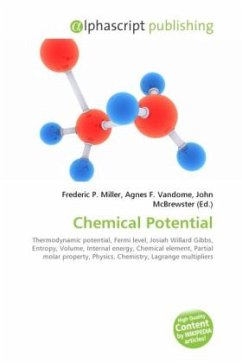
High Quality Content by WIKIPEDIA articles! Chemical potential, symbolized by , is a quantity first described by the American engineer, chemist and mathematical physicist Josiah Williard Gibbs. He defined it as follows: If to any homogeneous mass in a state of hydrostatic stress we suppose an infinitesimal quantity of any substance to be added, the mass remaining homogeneous and its entropy and volume remaining unchanged, the increase of the energy of the mass divided by the quantity of the substance added is the potential for that substance in the mass considered. Gibbs noted also that for the purposes of this definition, any chemical element or combination of elements in given proportions may be considered a substance, whether capable or not of existing by itself as a homogeneous body. Chemical potential is also referred to as partial molar Gibbs energy (see also partial molar property). The chemical potential is used in thermodynamics, physics and chemistry. In modern statistical physics the chemical potential is the Lagrange multiplier for the average particle constraint, when maximizing the entropy, divided by the temperature.
Andere Kunden interessierten sich für