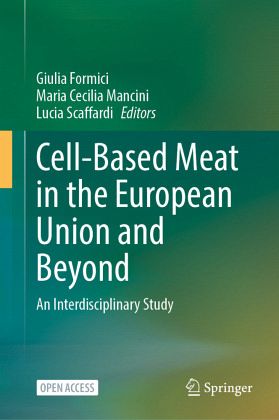
Cell-Based Meat in the European Union and Beyond
An Interdisciplinary Study
Herausgegeben: Formici, Giulia; Mancini, Maria Cecilia; Scaffardi, Lucia
Versandkostenfrei!
Erscheint vorauss. Mai 2026
38,99 €
inkl. MwSt.

This open access book presents a thorough and up-to-date exploration of the complex and often controversial topic of cell-based meat. In a world facing pressing food security challenges, innovations in the agri-food sector including Novel Foods like insects and especially cell-based meat are at the heart of ongoing political, legislative, economic, scientific, and ethical discussions.Focusing specifically on cultured meat, the book presents a research-driven analysis intended to serve a wide audience. Policymakers, public authorities, food industry professionals, researchers, students, and the...
This open access book presents a thorough and up-to-date exploration of the complex and often controversial topic of cell-based meat. In a world facing pressing food security challenges, innovations in the agri-food sector including Novel Foods like insects and especially cell-based meat are at the heart of ongoing political, legislative, economic, scientific, and ethical discussions.
Focusing specifically on cultured meat, the book presents a research-driven analysis intended to serve a wide audience. Policymakers, public authorities, food industry professionals, researchers, students, and the general public will find valuable insights to help them navigate this multifaceted issue and counter the risks posed by misinformation, and ideologically driven narratives.
To address the varied and interconnected questions surrounding cell-based meat, the book adopts an interdisciplinary approach, drawing on the expertise and research of scholars from the University of Parmaand other Italian and international institutions. The diverse team of authors specialized in law, economics, food chemistry, animal nutrition and more has contributed to numerous studies, projects, and events over recent years, tackling the various challenges this emerging food technology poses.
The book is structured into three distinct parts. The first addresses scientific and sustainability issues, paying specific attention to open questions on food safety, as well as to the role of EFSA. Offering a comparative perspective, the second part examines the evolving legal and policy frameworks within and beyond the European Union. It discusses topics such as animal welfare, marketing regulations, and labelling practices, highlighting the diverse approaches countries are taking from investing in these future foods, to banning their production or sale. The final part focuses on consumer perceptions, emerging consumption patterns, and religious considerations. Through its accessible, science-based analysis of legal, ethical, scientific, and economic aspects, the book provides a well-rounded resource to support informed public debate and decision-making on a topic that is rapidly gaining global attention.
Focusing specifically on cultured meat, the book presents a research-driven analysis intended to serve a wide audience. Policymakers, public authorities, food industry professionals, researchers, students, and the general public will find valuable insights to help them navigate this multifaceted issue and counter the risks posed by misinformation, and ideologically driven narratives.
To address the varied and interconnected questions surrounding cell-based meat, the book adopts an interdisciplinary approach, drawing on the expertise and research of scholars from the University of Parmaand other Italian and international institutions. The diverse team of authors specialized in law, economics, food chemistry, animal nutrition and more has contributed to numerous studies, projects, and events over recent years, tackling the various challenges this emerging food technology poses.
The book is structured into three distinct parts. The first addresses scientific and sustainability issues, paying specific attention to open questions on food safety, as well as to the role of EFSA. Offering a comparative perspective, the second part examines the evolving legal and policy frameworks within and beyond the European Union. It discusses topics such as animal welfare, marketing regulations, and labelling practices, highlighting the diverse approaches countries are taking from investing in these future foods, to banning their production or sale. The final part focuses on consumer perceptions, emerging consumption patterns, and religious considerations. Through its accessible, science-based analysis of legal, ethical, scientific, and economic aspects, the book provides a well-rounded resource to support informed public debate and decision-making on a topic that is rapidly gaining global attention.
Andere Kunden interessierten sich für