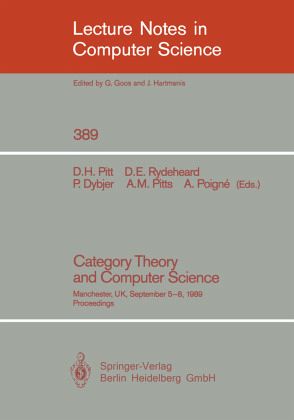
Category Theory and Computer Science
Manchester, UK, September 5-8, 1989. Proceedings
Herausgegeben: Pitt, David H.; Rydehaerd, David E.; Dybjer, Peter; Pitts, Andrew M.; Poigne, Axel
Versandkostenfrei!
Versandfertig in 1-2 Wochen
36,99 €
inkl. MwSt.

PAYBACK Punkte
18 °P sammeln!

Coherence and valid isomorphism in closed categories applications of proof theory to category theory in a computer sclentist perspective.- An algebraic view of interleaving and distributed operational semantics for CCS.- Temporal structures.- Compositional relational semantics for indeterminate dataflow networks.- Operations on records.- Projections for polymorphic strictness analysis.- A category-theoretic account of program modules.- A note on categorical datatypes.- A set constructor for inductive sets in Martin-Löf's type theory.- Independence results for calculi of dependent types.- Quan...
Coherence and valid isomorphism in closed categories applications of proof theory to category theory in a computer sclentist perspective.- An algebraic view of interleaving and distributed operational semantics for CCS.- Temporal structures.- Compositional relational semantics for indeterminate dataflow networks.- Operations on records.- Projections for polymorphic strictness analysis.- A category-theoretic account of program modules.- A note on categorical datatypes.- A set constructor for inductive sets in Martin-Löf's type theory.- Independence results for calculi of dependent types.- Quantitative domains, groupoids and linear logic.- Graded multicategories of polynomial-time realizers.- On the semantics of second order lambda calculus: From bruce-meyer-mitchell models to hyperdoctrine models and vice-versa.- Dictoses.- Declarative continuations: An investigation of duality in programming language semantics.- Logic representation in LF.- Unification properties of commutative theories: A categorical treatment.- An abstract formulation for rewrite systems.- From petri nets to linear logic.- A dialectica-like model of linear logic.- A final coalgebra theorem.
Andere Kunden interessierten sich für