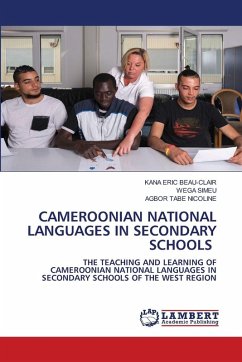
CAMEROONIAN NATIONAL LANGUAGES IN SECONDARY SCHOOLS
THE TEACHING AND LEARNING OF CAMEROONIAN NATIONAL LANGUAGES IN SECONDARY SCHOOLS OF THE WEST REGION
Versandkostenfrei!
Versandfertig in 6-10 Tagen
64,99 €
inkl. MwSt.

PAYBACK Punkte
32 °P sammeln!

This work set out to investigate and assess the effectiveness of teaching and learning Cameroonian national languages. It examined factors that can influence various actors towards the teaching and learning of those languages, the teaching and evaluation methods, the syllabus and made proposals to facilitate the teachers' and the students' work. The data were obtained from questionnaire, interview and classroom observation, involving 02 Regional Pedagogic Inspectors, 320 students and 42 teachers of National Languages and Cultures selected through random and purposive sampling in 23 secondary s...
This work set out to investigate and assess the effectiveness of teaching and learning Cameroonian national languages. It examined factors that can influence various actors towards the teaching and learning of those languages, the teaching and evaluation methods, the syllabus and made proposals to facilitate the teachers' and the students' work. The data were obtained from questionnaire, interview and classroom observation, involving 02 Regional Pedagogic Inspectors, 320 students and 42 teachers of National Languages and Cultures selected through random and purposive sampling in 23 secondary schools of the West Region. Based on Stufflebeam's (2003) CIPP Evaluation Model, Bowen's (2009) Document Analysis theory and Richards' (2006) Communicative Language Teaching, the analyses of data reveal that teachers' attitudes depend on issues such as their field of study, qualifications, longevity, mastery and daily use of the languages taught. They face a number of difficulties in their work like lack of didactic material, lack of continuous training, the multilingual nature of classes, the insufficient teaching hours. As concerns the students, a great majority of them are conscious.
Andere Kunden interessierten sich für