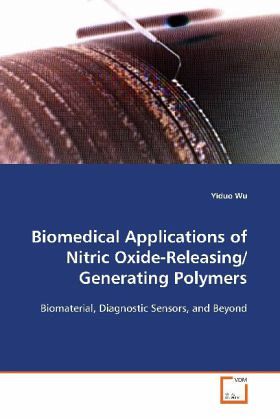
Biomedical Applications of Nitric Oxide- Releasing/Generating Polymers
Biomaterial, Diagnostic Sensors, and Beyond
Versandkostenfrei!
Versandfertig in 6-10 Tagen
39,99 €
inkl. MwSt.

PAYBACK Punkte
20 °P sammeln!

Nitric oxide is secreted by vascularendothelium and can inhibit the activation andadhesion of platelets, prevent inflammation andinduce vasodilation. Polymers that continuously produces NO at their surfacesare expected to exhibit enhanced biocompatibility. In this work, the biocompatibility of novelNO-releasing/generating materials has been evaluatedvia both in vitro and in vivo studies. An in vitro platelet adhesion assay has been designedto quantify platelet adhesion on polymer surfaces viatheir lactate dehydrogenase content. Such an assaycan be employed as a preliminary screening tool inthe...
Nitric oxide is secreted by vascular
endothelium and can inhibit the activation and
adhesion of platelets, prevent inflammation and
induce vasodilation. Polymers that continuously
produces NO at their surfaces
are expected to exhibit enhanced biocompatibility.
In this work, the biocompatibility of novel
NO-releasing/generating materials has been evaluated
via both in vitro and in vivo studies.
An in vitro platelet adhesion assay has been designed
to quantify platelet adhesion on polymer surfaces via
their lactate dehydrogenase content. Such an assay
can be employed as a preliminary screening tool in
the assessment of new NO-releasing/generating
materials. In addition, the first in vivo evaluation
of NO-generating polymers was conducted. The
generation of NO via the decomposition of endogenous
S-nitrosothiols (RSNOs) showed enhanced
biocompatibility.
NO-generating polymers can also be utilized to
electrochemically detect
RSNO based on the decomposition to yield
NO. The advantage of the RSNO sensor is that
measurement can be made in whole blood samples
without any pretreatment, thereby minimizing any
artifacts associated with sample processing.
endothelium and can inhibit the activation and
adhesion of platelets, prevent inflammation and
induce vasodilation. Polymers that continuously
produces NO at their surfaces
are expected to exhibit enhanced biocompatibility.
In this work, the biocompatibility of novel
NO-releasing/generating materials has been evaluated
via both in vitro and in vivo studies.
An in vitro platelet adhesion assay has been designed
to quantify platelet adhesion on polymer surfaces via
their lactate dehydrogenase content. Such an assay
can be employed as a preliminary screening tool in
the assessment of new NO-releasing/generating
materials. In addition, the first in vivo evaluation
of NO-generating polymers was conducted. The
generation of NO via the decomposition of endogenous
S-nitrosothiols (RSNOs) showed enhanced
biocompatibility.
NO-generating polymers can also be utilized to
electrochemically detect
RSNO based on the decomposition to yield
NO. The advantage of the RSNO sensor is that
measurement can be made in whole blood samples
without any pretreatment, thereby minimizing any
artifacts associated with sample processing.
Andere Kunden interessierten sich für