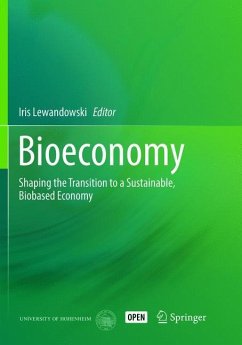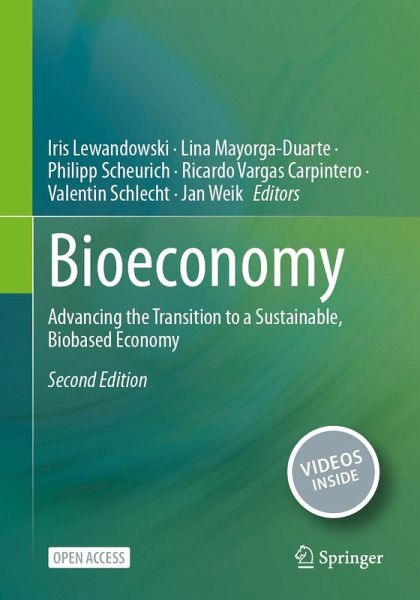
Bioeconomy
Advancing the Transition to a Sustainable, Biobased Economy
Herausgegeben: Lewandowski, Iris; Mayorga-Duarte, Lina; Scheurich, Philipp; Vargas Carpintero, Ricardo; Schlecht, Valentin; Weik, Jan
Versandkostenfrei!
Versandfertig in 6-10 Tagen
39,99 €
inkl. MwSt.

PAYBACK Punkte
20 °P sammeln!

This open access textbook is the carefully revised, second edition on the evolving field of the "Bioeconomy". It defines the sustainable and innovative use of biomass and biological knowledge to provide food, feed, industrial products, bioenergy, and ecological services. The book´s structure has been extensively updated and expanded to six parts. New chapters feature bioeconomy principles, sustainability and normative aspects, as well as bioeconomy monitoring. Additionally, a dedicated section explores diverse stakeholder perspectives, covering insights from farmers, consumers, researchers, a...
This open access textbook is the carefully revised, second edition on the evolving field of the "Bioeconomy". It defines the sustainable and innovative use of biomass and biological knowledge to provide food, feed, industrial products, bioenergy, and ecological services. The book´s structure has been extensively updated and expanded to six parts. New chapters feature bioeconomy principles, sustainability and normative aspects, as well as bioeconomy monitoring. Additionally, a dedicated section explores diverse stakeholder perspectives, covering insights from farmers, consumers, researchers, and others. Contributions highlight the importance of bioeconomy-related concepts in public, scientific, and political discourse. The expert authors use an interdisciplinary approach and outline the dimensions of the bioeconomy as a means of achieving sustainability.
The book parts cover:
Bioeconomy Context, Concepts and Principles
Biomass Production Systems
Biomass Processing
Markets for Bio-based Products & Economics for a Sustainable Bioeconomy
Stakeholders of the Bioeconomy
Guiding the Bioeconomy Transition
Vividly redesigned and enriched by two types of videos (deepening course material as well as chapter summaries presented by virtual student ambassadors), this volume provides university students and all interested readers with extensive knowledge around the bioeconomy. You can also benefit from the videos in the print version through the free Springer Nature More Media App. Using definitions and excursuses, this new work familiarizes you with bioeconomy-related terms and gives scientific background for economists, agronomists, and natural scientists alike. To test comprehension and consolidate your learning, each chapter concludes with a Questions & Answers section. Finally, as the bioeconomy is increasingly recognized as a strategy for achieving the UN Sustainable Development Goals (SDGs), this work is a must-read for anyone interested in the green economy, the circular economy, and sustainable development.
The book parts cover:
Bioeconomy Context, Concepts and Principles
Biomass Production Systems
Biomass Processing
Markets for Bio-based Products & Economics for a Sustainable Bioeconomy
Stakeholders of the Bioeconomy
Guiding the Bioeconomy Transition
Vividly redesigned and enriched by two types of videos (deepening course material as well as chapter summaries presented by virtual student ambassadors), this volume provides university students and all interested readers with extensive knowledge around the bioeconomy. You can also benefit from the videos in the print version through the free Springer Nature More Media App. Using definitions and excursuses, this new work familiarizes you with bioeconomy-related terms and gives scientific background for economists, agronomists, and natural scientists alike. To test comprehension and consolidate your learning, each chapter concludes with a Questions & Answers section. Finally, as the bioeconomy is increasingly recognized as a strategy for achieving the UN Sustainable Development Goals (SDGs), this work is a must-read for anyone interested in the green economy, the circular economy, and sustainable development.
Andere Kunden interessierten sich für