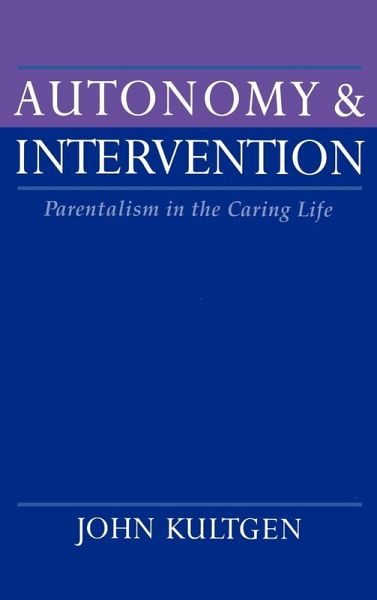
Autonomy and Intervention
Parentalism in the Caring Life

PAYBACK Punkte
78 °P sammeln!

The basic relationship between people should be care, and the caring life is the highest which humans can live. Unfortunately, care that is not thoughtful slides into illegitimate intrusion on autonomy. Autonomy is a basic good, and we should not abridge it without good reason. On the other hand, it is not the only good. We must sometimes intervene in the lives of others to protect them from grave harms or provide them with important benefits. The reflective person, therefore, needs guidelines for caring. Some contemporary moralists condemn paternalism categorically. This work examines weaknesses in their arguments and proposes new guidelines for paternalism, which it calls "parentalism" to avoid the patriarchal connotations of the old term. Its antiparentalism is more moderate than standard antipaternalism based on an exaggerated respect for autonomy. The work explores implications for both the personal sphere of interactions between individuals, such as friends and family members, and the public sphere of institutions, legislation, and the professional practices.
The basic relationship between people should be one of care, and the caring life is the highest which humans can live. Unfortunately, care that is ill-considered can easily become an illegitimate intrusion on autonomy. Autonomy is a basic good, not to be abridged without good reason. It is not, on the other hand, the only good. Kultgen argues that it is sometimes necessary to intervene in the lives of others in order to protect them from harm or provide important benefits. Guidelines, therefore, must be established so that care is both respectful and balanced. Some contemporary moralists categorically condemn paternalism, the forementioned intervention without consent. Kultgen examines weaknesses in these arguments and proposes new guidelines for paternalism, which he then names parentalism. As the term implies, Kultgen's reconception abandons the patriarchal connotations of the old term, relying instead on the optimal caring roles characteristic of "mothers" and "fathers". Kultgen distinguishes between the personal sphere of interaction (i.e., friends, family, and intimates), and the public sphere of institutions, legislation, and the professional practices, and goes on to explore the implication of parentalism in both these spheres. Though Kultgen agrees that paternalistic intervention is morally dangerous, he makes the case that it is equally dangerous to decline to intervene when another's welfare is in jeopardy.
Andere Kunden interessierten sich für