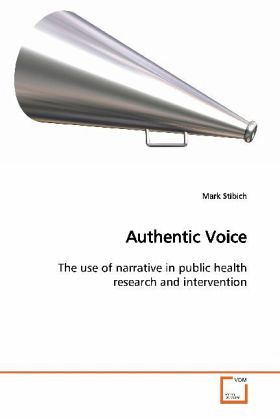
Authentic Voice
The use of narrative in public health research and intervention
Versandkostenfrei!
Versandfertig in 6-10 Tagen
45,99 €
inkl. MwSt.

PAYBACK Punkte
23 °P sammeln!

Authentic voice represents an adaptation of narrativeapproaches for use in public health settings.Authentic voice approaches utilize narratives fromthe target population to accomplish public healthgoals. Authentic refers to the first-hand experienceof the narrators while voice refers to the expressionof the narrative in terms understandable by thetarget population while maintaining the individualityof the narrator. In the first paper, a discussion ofthe potential of using narratives from the targetpopulation as 1) a direct intervention; 2) a form ofpersuasive communications; and 3) a source of...
Authentic voice represents an adaptation of narrative
approaches for use in public health settings.
Authentic voice approaches utilize narratives from
the target population to accomplish public health
goals. Authentic refers to the first-hand experience
of the narrators while voice refers to the expression
of the narrative in terms understandable by the
target population while maintaining the individuality
of the narrator. In the first paper, a discussion of
the potential of using narratives from the target
population as 1) a direct intervention; 2) a form of
persuasive communications; and 3) a source of
information for research into various topics. The
second paper examines the patient experience of
acupuncture using narrative drawn from interviews
with and letters from acupuncture patients using a
content oriented approach. The third paper examines
the importance of meaning shift over the course of
acupuncture treatment.
approaches for use in public health settings.
Authentic voice approaches utilize narratives from
the target population to accomplish public health
goals. Authentic refers to the first-hand experience
of the narrators while voice refers to the expression
of the narrative in terms understandable by the
target population while maintaining the individuality
of the narrator. In the first paper, a discussion of
the potential of using narratives from the target
population as 1) a direct intervention; 2) a form of
persuasive communications; and 3) a source of
information for research into various topics. The
second paper examines the patient experience of
acupuncture using narrative drawn from interviews
with and letters from acupuncture patients using a
content oriented approach. The third paper examines
the importance of meaning shift over the course of
acupuncture treatment.
Andere Kunden interessierten sich für


![Cover Creating Inner Harmony: Using Your Voice and Music to Heal [With All-Music CD]](https://bilder.buecher.de/produkte/21/21591/21591132n.jpg "Creating Inner Harmony: Using Your Voice and Music to Heal [With All-Music CD]")