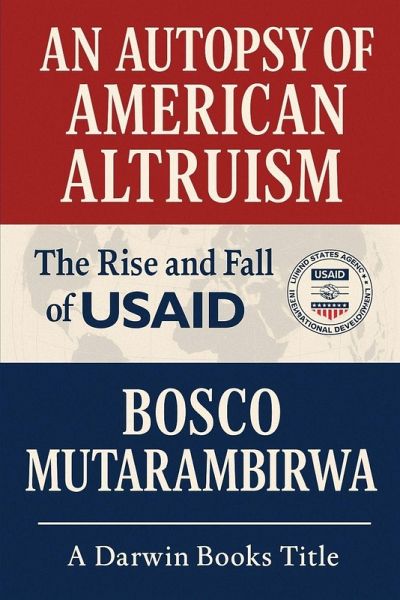
AN AUTOPSY OF AMERICAN ALTRUISM
The Rise and Fall of USAID

PAYBACK Punkte
12 °P sammeln!

For more than six decades, USAID served as the outward expression of American goodwill and global leadership. Created in the optimistic fervor of the early Cold War, the agency promised partnership, stability, and development to nations struggling with poverty, conflict, and institutional collapse. Yet behind the soaring language of altruism lay a more complicated reality-one shaped by political agendas, competing bureaucracies, strategic interests, and the shifting tides of U.S. foreign policy. As American influence expanded and contracted around the world, USAID became both a tool of nationa...
For more than six decades, USAID served as the outward expression of American goodwill and global leadership. Created in the optimistic fervor of the early Cold War, the agency promised partnership, stability, and development to nations struggling with poverty, conflict, and institutional collapse. Yet behind the soaring language of altruism lay a more complicated reality-one shaped by political agendas, competing bureaucracies, strategic interests, and the shifting tides of U.S. foreign policy. As American influence expanded and contracted around the world, USAID became both a tool of national strategy and a mirror of America's evolving identity. An Autopsy of American Altruism offers the most comprehensive and unflinching examination to date of how USAID rose to prominence, how it functioned, and how it ultimately unraveled. Bosco Mutarambirwa traces the agency's arc from its founding under President Kennedy through its heyday in the 20th century to its fragmentation in the decades following 9/11. Drawing on global historical context, development economics, and geopolitical analysis, he reveals how misaligned incentives, ideological battles, and recurring waves of policy experimentation slowly eroded the agency's effectiveness. From Vietnam's nation-building failures to Afghanistan's reconstruction nightmares, from Latin America's political crosswinds to Africa's ambitious development experiments, USAID's history is inseparable from the broader history of American power. Mutarambirwa shows how aid projects were frequently shaped less by local needs and more by Washington priorities; how competing visions within the U.S. government created chronic instability; and how global rivals-including China, Russia, the Gulf states, and emerging regional powers-exploited America's inconsistencies to expand their influence. As new development models took hold across the Global South and traditional Western institutions struggled to adapt, USAID found itself increasingly adrift. Its identity blurred, its credibility weakened, and its strategic purpose questioned not only abroad but within the U.S. foreign policy establishment itself. The result, Mutarambirwa argues, was an agency unable to reconcile its founding ideals with the realities of a multipolar world. Urgent, deeply researched, and written with clarity and analytical depth, An Autopsy of American Altruism is more than the story of one agency's failure. It is a lens on the transformation of American global power and the limits of what development assistance can achieve when strategy, politics, and values collide. For policymakers, scholars, development practitioners, and citizens seeking to understand the future of U.S. leadership, this book provides a rare and essential guide to the past, present, and uncertain road ahead.
Andere Kunden interessierten sich für