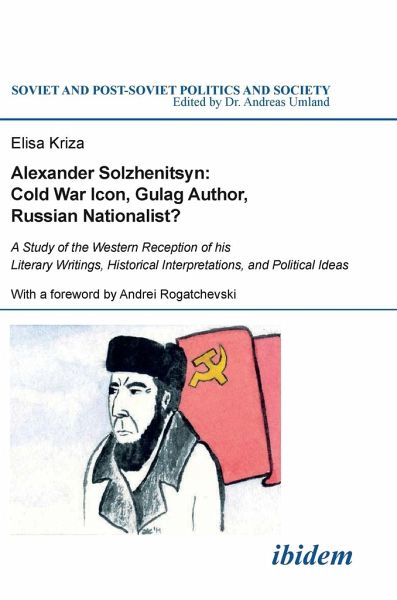
Alexander Solzhenitsyn
Cold War Icon, Gulag Author, Russian Nationalist?. A Study of the Western Reception of his Literary Writings, Historical Interpretations, and Political Ideas
Herausgegeben: Umland, Andreas;Mitarbeit: Rogatchevski, Andrei
Versandkostenfrei!
Versandfertig in 1-2 Wochen
59,90 €
inkl. MwSt.

PAYBACK Punkte
0 °P sammeln!

Alexander Solzhenitsyn was one of the Cold War`s most iconic writers. This book offers an in-depth analysis of his reception in the US, UK, and Germany before and after 1991. Elisa Kriza skillfully explores how Solzhenitsyn`s work can be understood with the paradigm of witness literature and uncovers the dynamics behind the politicized reception of his writing.From the mid-1980s onwards, Solzhenitsyn`s popularity dwindled was this for ideological reasons? What about the rumors linking him with Russian nationalism? This study does not shy away from stretching beyond anti-communism and touching ...
Alexander Solzhenitsyn was one of the Cold War`s most iconic writers. This book offers an in-depth analysis of his reception in the US, UK, and Germany before and after 1991. Elisa Kriza skillfully explores how Solzhenitsyn`s work can be understood with the paradigm of witness literature and uncovers the dynamics behind the politicized reception of his writing.
From the mid-1980s onwards, Solzhenitsyn`s popularity dwindled was this for ideological reasons? What about the rumors linking him with Russian nationalism? This study does not shy away from stretching beyond anti-communism and touching more contentious subjects such as anti-feminism, anti-Semitism, and revisionism in Solzhenitsyn`s work and reception.
Bringing Solzhenitsyn back from his `critical exile` and redefining his work as memory culture, Kriza`s book is a crucial scholarly intervention, unveiling the mechanism that can transform a controversial figure into a moral icon.
From the mid-1980s onwards, Solzhenitsyn`s popularity dwindled was this for ideological reasons? What about the rumors linking him with Russian nationalism? This study does not shy away from stretching beyond anti-communism and touching more contentious subjects such as anti-feminism, anti-Semitism, and revisionism in Solzhenitsyn`s work and reception.
Bringing Solzhenitsyn back from his `critical exile` and redefining his work as memory culture, Kriza`s book is a crucial scholarly intervention, unveiling the mechanism that can transform a controversial figure into a moral icon.