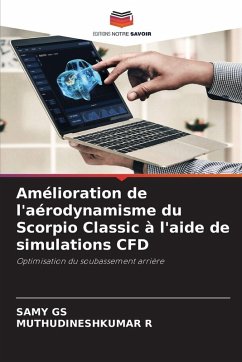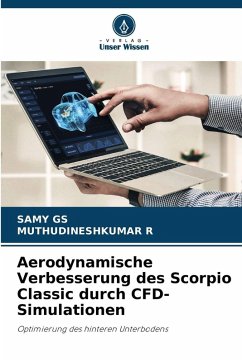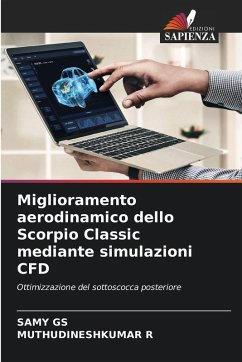
Aerodynamic Enhancement of Scorpio Classic Using CFD Simulations
Rear Underbody Optimization
Versandkostenfrei!
Versandfertig in 6-10 Tagen
29,99 €
inkl. MwSt.

PAYBACK Punkte
15 °P sammeln!

This study investigates the aerodynamic performance of the 2013 Scorpio Classic using computational fluid dynamics (CFD) simulations in ANSYS Fluent. A baseline 2D model was developed and analyzed for drag and lift coefficients, followed by a modified design incorporating a boat tail angle at the rear underbody. The simulations were conducted at an inlet velocity of 27.7 m/s with the SST k- turbulence model. Results show that the modified model achieved a notable reduction in aerodynamic drag and lift compared to the base model. Specifically, the drag coefficient decreased from 3.45 (base mode...
This study investigates the aerodynamic performance of the 2013 Scorpio Classic using computational fluid dynamics (CFD) simulations in ANSYS Fluent. A baseline 2D model was developed and analyzed for drag and lift coefficients, followed by a modified design incorporating a boat tail angle at the rear underbody. The simulations were conducted at an inlet velocity of 27.7 m/s with the SST k- turbulence model. Results show that the modified model achieved a notable reduction in aerodynamic drag and lift compared to the base model. Specifically, the drag coefficient decreased from 3.45 (base model) to 2.95 (Model 1), while the lift coefficient reduced from 2.80 to 2.40, indicating enhanced stability and fuel efficiency potential. The findings demonstrate that strategic modifications, such as rear underbody optimization, can significantly improve vehicle aerodynamic efficiency. This work underscores the importance of CFD-based design approaches in automotive aerodynamics and provides insights for future design optimization.
Andere Kunden interessierten sich für