Abstract Algebra
Versandkostenfrei!
Versandfertig in 6-10 Tagen
42,99 €
inkl. MwSt.

PAYBACK Punkte
21 °P sammeln!

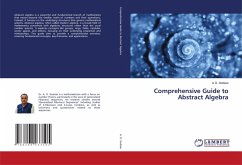
High Quality Content by WIKIPEDIA articles! Abstract algebra is the subject area of mathematics that studies algebraic structures, such as groups, rings, fields, modules, vector spaces, and algebras. The phrase abstract algebra was coined at the turn of the 20th century to distinguish this area from what was normally referred to as algebra, the study of the rules for manipulating formulae and algebraic expressions involving unknowns and real or complex numbers, often now called elementary algebra. The distinction is rarely made in more recent writings. Contemporary mathematics and mathematical...
High Quality Content by WIKIPEDIA articles! Abstract algebra is the subject area of mathematics that studies algebraic structures, such as groups, rings, fields, modules, vector spaces, and algebras. The phrase abstract algebra was coined at the turn of the 20th century to distinguish this area from what was normally referred to as algebra, the study of the rules for manipulating formulae and algebraic expressions involving unknowns and real or complex numbers, often now called elementary algebra. The distinction is rarely made in more recent writings. Contemporary mathematics and mathematical physics make intensive use of abstract algebra; for example, theoretical physics draws on Lie algebras. Subject areas such as algebraic number theory, algebraic topology, and algebraic geometry apply algebraic methods to other areas of mathematics. Representation theory, roughly speaking, takes the 'abstract' out of 'abstract algebra', studying the concrete side of a given structure; see model theory. Two mathematical subject areas that study the properties of algebraic structures viewed as a whole are universal algebra and category theory. Algebraic structures, together with the associated homomorphisms, form categories.
Andere Kunden interessierten sich für