

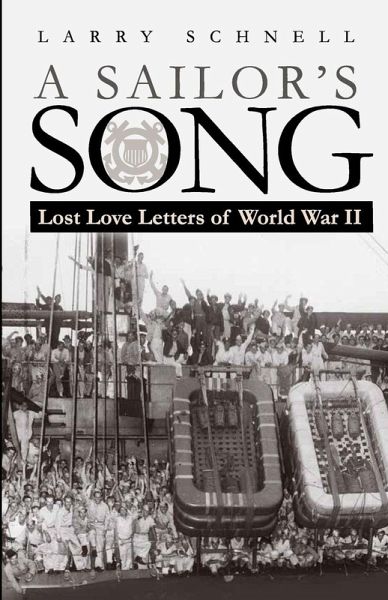
A Sailor's Song
Lost Love Letters of World War II
Versandkostenfrei!
Versandfertig in über 4 Wochen
12,99 €
inkl. MwSt.

PAYBACK Punkte
6 °P sammeln!

A Sailor's Song: Lost Love Letters of World War II is the story of the Coast Guard's Manhattan Beach Training Station bands and its musicians as told through military records and letters. Throughout much of the war, the Manhattan Beach Coast Guard musicians played in multiple bands-full military bands, marching bands for bond rallies, dance bands, and smaller ensembles for officers' balls, sick bay, and special events. During the last year of the war, most Manhattan Beach musicians were abruptly assigned to the U.S.S. General A.W. Greely, a new troop transport ship that would carry troops betw...
A Sailor's Song: Lost Love Letters of World War II is the story of the Coast Guard's Manhattan Beach Training Station bands and its musicians as told through military records and letters. Throughout much of the war, the Manhattan Beach Coast Guard musicians played in multiple bands-full military bands, marching bands for bond rallies, dance bands, and smaller ensembles for officers' balls, sick bay, and special events. During the last year of the war, most Manhattan Beach musicians were abruptly assigned to the U.S.S. General A.W. Greely, a new troop transport ship that would carry troops between the homeland and the Pacific war. Commander George W. Stedman Jr. recognized the value of musical entertainment on board. Under his direction, the Greely was equipped with two organs and a piano, a musical instrument room, special quarters for musicians, and a sound system throughout the ship that broadcast music of the Greely Grenadiers, as the Manhattan Beach band was named. With the Grenadiers playing for the ship's commissioning and continuing beyond the war's end, the Greely earned the reputation as the only ship in the war that had its own band from the start of service. Bands rehearsed and performed daily on deck throughout the Indian and Pacific oceans on three voyages, one a circumnavigation, as well as a transatlantic voyage. On return from her second Pacific voyage, the Greely brought home from the Pacific Theater the most war-weary troops-Merrill's Marauders, the Flying Tigers, the U.S. Army engineers who built the Ledo Road through Burma, the Kachin Rangers who enlisted indigenous people to fight the Japanese, and other service groups. These famed fighters debarked the Greely in New York to the cheers of thousands and to the music of the Greely Grenadiers. The story of music on the Greely, told through more than 100 letters as well as Coast Guard and Navy documents, provides a view of the war from perspectives of sailors aboard the ship and loved ones at home. Portraits of a dozen musicians and their wives reflect the struggles many thousands of war couples endured. To maintain marriages through correspondence, musicians laced their letters with code to inform spouses of their location as they dodged the scrutiny of Navy censors. These encrypted locations together with the Greely's war diaries plot the course of thousands of troops to and from the Pacific theater in the context of war events such as the death of President Roosevelt, the Mitchell bomber that crashed into the Empire State Building, the sinking of the U.S.S. Indianapolis, the bombing of Hiroshima, the riots of troops stranded in post-war outposts, and other high-profile events.