Andere Kunden interessierten sich auch für
 Financial Econometrics, Mathematics and Statistics133,99 €
 Statistik für Wirtschaftswissenschaftler39,99 €
 Multivariate Methods and Forecasting with IBM® SPSS® Statistics37,99 €
 Quantitative Analysis and IBM® SPSS® Statistics37,99 €
 Co-patenting: An Analytic Tool for Cooperative Research and Development74,99 €
 Ökonometrie39,99 €
 Time Series Econometrics131,99 €

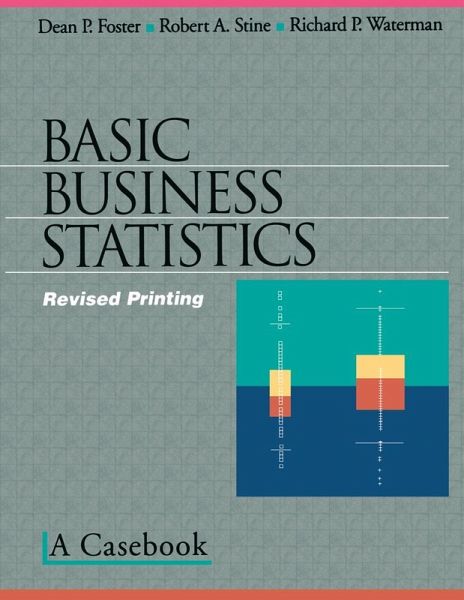
Preface Statistics is seldom the most eagerly anticipated course of a business student. It typically has the reputation of being a boring, complicated, and confusing mix of mathematical formulas and computers. Our goal in writing this casebook and the companion volume (Business Analysis Using Regression) was to change that impression by showing how statistics yields insights and answers interesting business questions. Rather than dwell on underlying formulas, we show how to use statistics to answer questions. Each case study begins with a business question and concludes with an answer to that question. Formulas appear only as needed to address the questions, and we focus on the insights into the problem provided by the mathematics. The mathematics serves a purpose. The material in this casebook is organized into 11 "classes" of related case studies that develop a single, key idea of statistics. The analysis of data using statistics is seldom very straightforward, and each analysis has many nuances. Part of the appeal of statistics is this richness, this blending of substantive theories and mathematics. For newcomers, however, this blend is too rich, and they are easily overwhelmed and unable to sort out the important ideas from nuances. Although later cases in these notes suggest this complexity, we do not begin that way.
"The manuscripts are divided into "classes" which tackle various statistical concepts. Material becomes increasingly complex as the data in later sections exhibit multiple deviations from ideal conditions. The casebooks use a combination of explanatory text and software output to guide the student. Almost no mathematics appears in these volumes; the authors make traditional texts available to their students who are curious about the technical details...I anticipate students will wholeheartedly endorse the FSW casebooks. The material is easy to digest as, for instance, the authors cleverly interweave probability, the standard error of the mean, and control charts. The casebooks effectively relay the message that statistics is relevant and doable. Ideally, that is the message that should be sent in all introductory business statistics courses." Marlene Smith, University of Colorado-Denver