Andere Kunden interessierten sich auch für
 Language Attrition52,99 €
 Politeness in the History of English133,99 €
 Intercultural Politeness133,99 €
 The Language of Humor37,99 €
 The Cambridge Handbook of Systemic Functional Linguistics147,99 €
 Intercultural Politeness32,99 €
 Chinese Politeness126,99 €





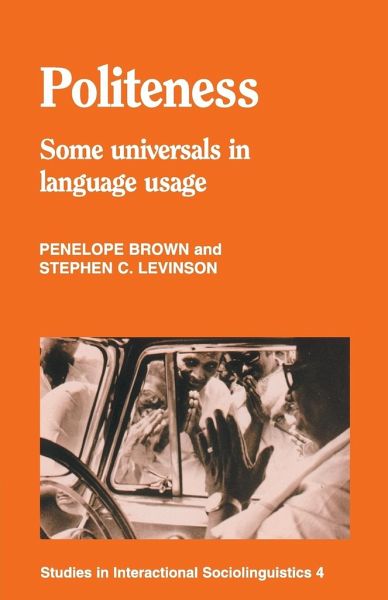
This book studies the principles for constructing polite speeches, based on the detailed study of three unrelated languages and cultures. The authors describe and account for some remarkable parallelisms in the linguistic construction of utterances with which people express themselves in different languages and cultures.
Hinweis: Dieser Artikel kann nur an eine deutsche Lieferadresse ausgeliefert werden.
Hinweis: Dieser Artikel kann nur an eine deutsche Lieferadresse ausgeliefert werden.
It has continued to inspire empirical work as 'the' source on politeness and, more generally, as an important exemplar in the study of the relationship between language and society. In addition, the broad scope of their treatment of these concerns has created a work in which many, if not most, of the assumptions guiding the contemporary study of language use are to found." Douglas G. Glick, Semiotica (1996)