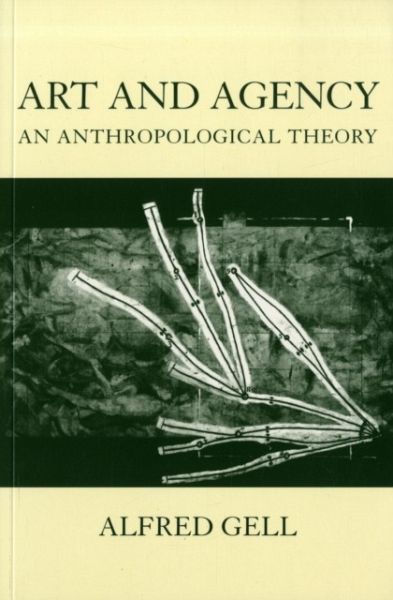
In Art and Agency, Alfred Gell formulates an anthropological theory
of visual art that focuses on the social context of art production,
circulation, and reception. As a theory of the nexus of social
relations involving works of art, this work suggests that in
certain contexts, art-objects substitute for persons and thus
mediate social agency. Diversely illustrated--and based on
European, Polynesian, Melanesian, and Australian sources--Art and
Agency was completed just before Gell's death at the age of
fifty-one in January 1997. It embodies the intellectual bravura,
lively wit, vigor, and erudition for which he was admired, and will
stand as an enduring testament to one of the most gifted
anthropologists of his generation.
Alfred Gell puts forward a new anthropological theory of visual
art, seen as a form of instrumental action: the making of things as
a means of influencing the thoughts and actions of others. He
argues that existing anthropological and aesthetic theories take an
overwhelmingly passive point of view, and questions the criteria
that accord art status only to a certain class of objects and not
to others. The anthropology of art is here reformulated as the
anthropology of a category of action: Gell shows how art objects
embody complex intentionalities and mediate social agency. He
explores the psychology of patterns and perceptions, art and
personhood, the control of knowledge, and the interpretation of
meaning, drawing upon a diversity of artistic traditions--European,
Indian, Polynesian, Melanesian, and Australian. Art and Agency was
completed just before Alfred Gell's death at the age of 51 in
January 1997. It embodies the intellectual bravura, lively wit,
vigour, and erudition for which he was admired, and will stand as
an enduring testament to one of the most gifted anthropologists of
his generation.
Review quote:
This book changes the very basis of the way art has been viewed in
the human sciences. It presents what is the first fundamental
theory for an anthropology of art. Its publication is a major
event.This is a remarkable work ... witty, elegant, broad in its
compass and scintillating in its detail. It is characteristically
polemical ... alive with his sense of purpose and his quite
original and captivating account of how we are captivated by
relations between forms ... The book know what to do with the
limits of form--one suddenly sees how anthropology might surpass
itself.An extraordinary achievement. Gell offers a profound new
understanding of collective agency which completely reshapes the
anthropology of art, redefines its objects of study, and inspires
new conclusions.
Alfred Gell puts forward a new anthropological theory of visual
art, seen as a form of instrumental action: the making of things as
a means of influencing the thoughts and actions of others. He shows
how art objects embody complex intentionalities and mediate social
agency, and he explores the psychology of patterns and perceptions,
art and personhood, the control of knowledge, and the
interpretation of meaning, drawing upon a diversity of artistic
traditions--European, Indian, Polynesian, Melanesian, and
Australian. Art and Agency was completed just before Alfred
Gell's death at the age of 51 in January 1997. It embodies the
intellectual bravura, lively wit, vigour, and erudition for which
he was admired, and will stand as an enduring testament to one of
the most gifted anthropologists of his generation.
Ausstattung/Bilder: numerous black and white halftones and line drawings
Seitenzahl: 296
Englisch
Abmessung: 236mm x 156mm x 22mm
Gewicht: 453g
ISBN-13: 9780198280149
ISBN-10: 0198280149
Best.Nr.: 21506304
This book changes the very basis of the way art has been viewed in the human sciences. It presents what is the first fundamental theory for an anthropology of art. Its publication is a major event. Maurice Bloch, FBA, Professor of Anthropology, London School of Economics. This is a remarkable work ... witty, elegant, broad in its compass and scintillating in its detail. It is characteristically polemical ... alive with his sense of purpose and his quite original and captivating account of how we are captivated by relations between forms ... The book know what to do with the limits of form--one suddenly sees how anthropology might surpass itself. Marilyn Strathern, FBA, Professor of Social Anthropology, University of Cambridge An extraordinary achievement. Gell offers a profound new understanding of collective agency which completely reshapes the anthropology of art, redefines its objects of study, and inspires new conclusions. Caroline Humphrey, Reader in Asian Anthropology, University of Cambridge
Alfred Gell is a former Reader in Anthropology in the London School of Economics.
Inhaltsangabe
Foreword 1. The Problem Defined: The Need for an Anthropology of Art 2. The Theory of the Art Nexus 3. The Art Nexus and the Index 4. The Involution of the Index in the Art Nexus 5. The Origination of the Index 6. The Critique of the Index 7. The Distributed Person 8. Style and Culture 9. Conclusion: The Extended Mind Bibliography Index