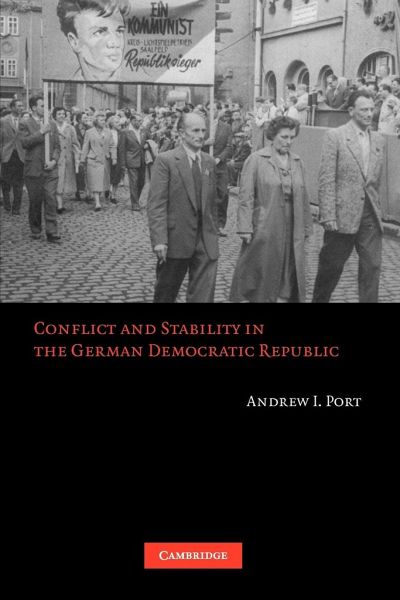
This book explores the reasons why the post-World War II Communist regime in East Germany outlasted both the Weimar Republic and the Third Reich.Hinweis: Dieser Artikel kann nur an eine deutsche Lieferadresse ausgeliefert werden.
Andrew I. Port is an Assistant Professor of History at Wayne State University, Detroit. He earned a PhD in history from Harvard University and a BA in history from Yale University. He has published articles in Social History and the Frankfürter Allgemeine Zeitung. Professor Port is a research associate at the Center for Russian and East European Studies at the University of Michigan, Ann Arbor, and he was a visiting scholar at the Zentrum für Zeithistorische Forschung (Center for Contemporary Historical Research) in Potsdam, Germany.
Inhaltsangabe
Part I. Upheaval (1945-53): 1. Creating a 'new order' 2. The GDR's 'first strike' 3. The revolution manqué of June 1953 Part II. The Calm after the Storm (1953-71): 4. The limits of repression 5. Exit, voice, and apathy 6. Power in the people's factories 7. Achieving harmony on the shop floor 8. Divide and rule? 9. 'I comes before we' in the countryside 10. 'Whatever happened to the classless society?'
Part I. Upheaval (1945-53): 1. Creating a 'new order' 2. The GDR's 'first strike' 3. The revolution manqué of June 1953 Part II. The Calm after the Storm (1953-71): 4. The limits of repression 5. Exit, voice, and apathy 6. Power in the people's factories 7. Achieving harmony on the shop floor 8. Divide and rule? 9. 'I comes before we' in the countryside 10. 'Whatever happened to the classless society?'
Es gelten unsere Allgemeinen Geschäftsbedingungen: www.buecher.de/agb
Impressum
www.buecher.de ist ein Shop der buecher.de GmbH & Co. KG Bürgermeister-Wegele-Str. 12, 86167 Augsburg Amtsgericht Augsburg HRA 13309