
Andere Kunden interessierten sich auch für
 UI is Communication44,99 €
 Design for Emotion29,99 €
 Mobile User Experience41,99 €
 Consuming Music Together119,99 €
 Frontiers of Human-Centered Computing, Online Communities and Virtual Environments232,99 €
 Designing Interfaces in Public Settings74,99 €
 OCUP 2 Certification Guide62,99 €







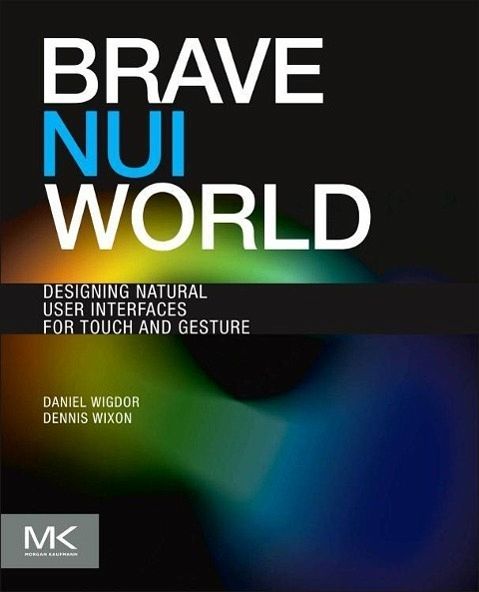
Brave NUI World is the first practical guide for designing touch- and gesture-based user interfaces. Written by the team from Microsoft that developed the multi-touch, multi-user Surface® tabletop product, it introduces the reader to natural user interfaces (NUI). It gives readers the necessary tools and information to integrate touch and gesture practices into daily work, presenting scenarios, problem solving, metaphors, and techniques intended to avoid making mistakes.
This book considers diverse user needs and context, real world successes and failures, and the future of NUI. It presents thirty scenarios, giving practitioners a multitude of considerations for making informed design decisions and helping to ensure that missteps are never made again.
The book will be of value to game designers as well as practitioners, researchers, and students interested in learning about user experience design, user interface design, interaction design, software design, human computer interaction, human factors, information design, and information architecture.
This book considers diverse user needs and context, real world successes and failures, and the future of NUI. It presents thirty scenarios, giving practitioners a multitude of considerations for making informed design decisions and helping to ensure that missteps are never made again.
The book will be of value to game designers as well as practitioners, researchers, and students interested in learning about user experience design, user interface design, interaction design, software design, human computer interaction, human factors, information design, and information architecture.
"Brave Nui World by Daniel Wigdor and Dennis Wixon is a must read for anyone involved in creating compelling user interfaces using modern technology and who, after testing, say 'Why didn't that design work the way it was intended?' To novices in the field, it will read as a how-to guide. For seasoned designers, it reads like a novel where you suspect the outcome but there is usually a twist in the plot, giving you that extra idea to think again. I genuinely enjoyed it and I am not likely to put it away soon."-Paul Neervoort, Lead User Experience Design, Philips Design
"A good grounding framework that immediately kindles ideas of how best to use NUI. Based on the developments of the past few decades, it provides solid foundations of NUI and develops these with the use of specific examples.While this isn't a cookbook, it does provide clear thematic guidance on how to make your NUI experience excel. The book covers basic through to advanced concepts in a very clear way. Good for reference, but even better if you read it cover to cover - you will grow immeasurably."--Dylan Evans, Principal Usability Consultant, Veluuria
"Interfaces are moving beyond our usual computers and into many facets of our lives. The way we design these interfaces is changing too. Brave NUI World helps highlight the new considerations you will need when designing for NUIs."--Daniel Naumann, User Experience Designer
"Wigdor and Wixon, both researchers working on the Microsoft Surface project, present this conceptual design guide for creating natural user interfaces (NUI) for next generation computer hardware. Covering technologies such as the Surface and other multi-touch and gestural devices, the authors discuss a variety of interface techniques and problems noting each issue's compliance with NUI guiding principles and recommending ways in which new development could more closely adhere to the NUI standards. The work includes numerous illustrations and tables."--Reference and Research Book News
"From a User Experience design perspective, touch and gestural interfaces are relatively new and there is a lot to be learnt. A good book to get your feet wet is Brave NUI World: Designing Natural User Interfaces for Touch and Gesture by Daniel Wigdor, Dennis Wixon.The style is more text-bookish, but this book promises to be a valuable reference guide for those designing for touch and gestures."--The Great Remix.com
"A good grounding framework that immediately kindles ideas of how best to use NUI. Based on the developments of the past few decades, it provides solid foundations of NUI and develops these with the use of specific examples.While this isn't a cookbook, it does provide clear thematic guidance on how to make your NUI experience excel. The book covers basic through to advanced concepts in a very clear way. Good for reference, but even better if you read it cover to cover - you will grow immeasurably."--Dylan Evans, Principal Usability Consultant, Veluuria
"Interfaces are moving beyond our usual computers and into many facets of our lives. The way we design these interfaces is changing too. Brave NUI World helps highlight the new considerations you will need when designing for NUIs."--Daniel Naumann, User Experience Designer
"Wigdor and Wixon, both researchers working on the Microsoft Surface project, present this conceptual design guide for creating natural user interfaces (NUI) for next generation computer hardware. Covering technologies such as the Surface and other multi-touch and gestural devices, the authors discuss a variety of interface techniques and problems noting each issue's compliance with NUI guiding principles and recommending ways in which new development could more closely adhere to the NUI standards. The work includes numerous illustrations and tables."--Reference and Research Book News
"From a User Experience design perspective, touch and gestural interfaces are relatively new and there is a lot to be learnt. A good book to get your feet wet is Brave NUI World: Designing Natural User Interfaces for Touch and Gesture by Daniel Wigdor, Dennis Wixon.The style is more text-bookish, but this book promises to be a valuable reference guide for those designing for touch and gestures."--The Great Remix.com