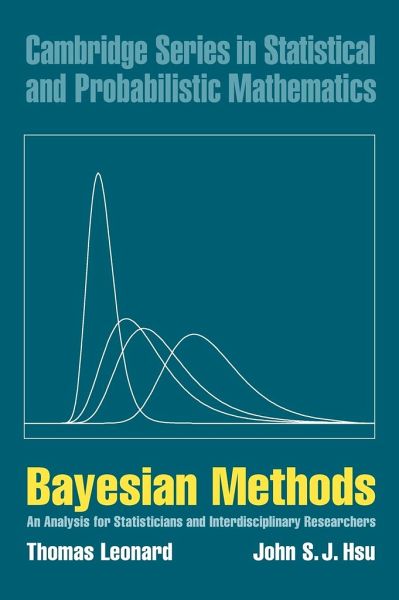
Bayesian Methods: An Analysis for Statisticians and Interdisciplinary Researchers
This book describes the Bayesian approach to statistics at a level
suitable for final year undergraduate and Masters students. It is
unique in presenting Bayesian statistics with a practical flavor
and an emphasis on mainstream statistics, showing how to infer
scientific, medical, and social conclusions from numerical data.
The authors draw on many years of experience with practical and
research programs and describe many new statistical methods, not
available elsewhere. A first chapter on Fisherian methods, together
with a strong overall emphasis on likelihood, makes the text
suitable for mainstream statistics courses whose instructors wish
to follow mixed or comparative philosophies. The other chapters
contain important sections relating to many areas of statistics
such as the linear model, categorical data analysis, time series
and forecasting, mixture models, survival analysis, Bayesian
smoothing, and non-linear random effects models. The text includes
a large number of practical examples, worked examples, and
exercises. It will be essential reading for all statisticians,
statistics students, and related interdisciplinary
researchers.
Table of contents:
1. Introductory statistical concepts; 2. The discrete version of
Bayes' theorem; 3. Models with a single unknown parameter; 4.
The expected utility hypothesis and its alternatives; 5. Models
with several unknown parameters; 6. Prior structures, posterior
smoothing, and Bayes-Stein estimation; Guide to worked examples;
Guide to self-study exercises.
Describes the Bayesian approach to statistics at a level suitable
for final year undergraduate and Masters students as well as
statistical and interdisciplinary researchers. It is unique in
presenting Bayesian statistics with an emphasis on mainstream
statistics, showing how to infer scientific, medical, and social
conclusions from numerical data.
Bayesian statistics directed towards mainstream statistics. How to
infer scientific, medical, and social conclusions from numerical
data.
'... challenging and worthwhile ... this book is a very welcome and original contribution to the literature on Bayesian statistics.' J. V. Zidek, ISI Short Book Reviews 'The book makes interesting reading and the breadth of ideas tackled by the authors is enormous ... deserves a place in the university library as well as in the personal libraries of researchers who are interested in the Bayesian approach.' Carmen Fernandez, The Statistician 'The book is highly recommended as a well written intermediate book on some modern topics of Bayesian analysis.' H. K. van Dijk, Niew Archief voor Wiskunde 'The explanations stated in the book are very clear, the detailed computations, and the particular way of describing problems, theorems and applications in this book make it useful into only for statisticians but also for other researchers who are confronted with problems of data analysis and who are not primarily familiar with statistical methods.' Monatshefte fur Mathematik 'A very readable and interesting book.' Indian Journal of Statistics
Inhaltsangabe
1. Introductory statistical concepts 2. The discrete version of Bayes' theorem 3. Models with a single unknown parameter 4. The expected utility hypothesis and its alternatives 5. Models with several unknown parameters 6. Prior structures, posterior smoothing, and Bayes-Stein estimation Guide to worked examples Guide to self-study exercises.