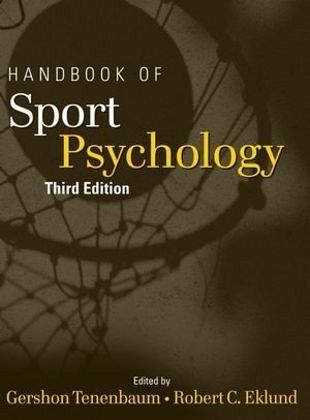
The most comprehensive and influential reference work on sport
psychologyNow in its third edition, the Handbook of Sport
Psychology provides an invaluable source of important theoretical
and applied information on sport psychology for students,
educators, and psychologists concerned with optimizing human
performance and improving health and well-being.Endorsed by the
International Society of Sport Psychology, this classic reference
draws on an international roster of experts and scholars in the
field who have assembled state-of-the-art knowledge into this
thorough, well-rounded, and accessible volume. The Handbook of
Sport Psychology, Third Edition is completely updated to reflect
the latest research and its impact on teaching and clinical
applications with topics ranging from emotions, cognition,
expertise, and social interactions in sport, to issues around
gender and cultural diversity.Recognized as a gold standard
resource thanks to its breadth of topics, excellent contributors,
and timely topics, the Handbook of Sport Psychology, Third Edition
is an indispensable resource for any student or professional
interested in the field of sport psychology.
"...is a comprehensive reference source to all aspects of the field. An outstanding aspect of the work is that the authors use an integrated approach to the field, weaving together the biological, emotional, and cognitive aspects of sport psychology. This work is essential for students and researchers in exercise and sport science, kinesiology, sports psychology, and related fields and highly recommended for academic libraries." (American Reference Books Annual, 2008) "... there is no question that the Handbookin its third edition is a landmark in the domain and history of sport psychology. It is a book that will help anyone working in sport or interested in sport, it is a must for sport psychologists, and it is absolutely indispensable for anyone who does research in sport-psychologists and medical investigators alike." (PsycCRITIQUES, December 2007)
GERSHON TENENBAUM, PHD, is a Professor at Florida State University in the Department of Educational Psychology and Learning Systems. He is past president of the International Society of Sport Psychology (ISSP) and the Editor of the International Journal of Sport and Exercise Psychology. He is a Fellow of the American Academy of Kinesiology and Physical Education and the American Association of Applied Sport Psychology, and Director of the Ribstein Center for Research and Sport Medicine at the Wingate Institute in Israel.
ROBERT C. EKLUND, PHD, is a Professor at Florida State University in the Department of Educational Psychology and Learning Systems. He is a Fellow of the American College of Sports Medicine (ACSM), a member of the International Society of Sport Psychology (ISSP), the North American Society for the Psychology of Sport and Physical Activity (NASPSPA), and the Association for the Advancement of Applied Sport Psychology (AAASP). He is Editor in Chief of the Journal of Sport & Exercise Psychology.
Inhaltsangabe
Foreword. Contributors. Reviewers.
PART I. MOTIVATIONAL, EMOTION, AND PSYCHOPYSIOLOGY. 1. Understanding the Dynamic of Motivation in Sport and Physical Activity: An Achievement Goal Interpretation. 2. Emotions in Sport: Current Issues and Perspectives. 3. Intrinsic and Extrinsic Motivation in Sport and Physical Activity: A Review and a Look at the Future. 4. The Psychology of Superior Sport Performance: A Cognitive and Affective Neuroscience perspective.
PART II. SOCIAL PERSPECTIVES. 5. Leadership in Sports. 6. Who cares What Other People Thing? Self-Presentation in Exercise and Sport.
PART III. SPORT EXPERTISE. 7. Methodological Review and Evaluation of Research in Expert performance in Sport. 8. Practice and Play in the Development of Sport Expertise. 9. Anticipation and Decision Making: Exploring New Horizons. 10. Degenerate Brains, Indeterminate Behavior, and Representative Tasks: Implications for Experimental Design in Sport Psychology Research. 11. Attentional Processes in Skill Learning and Expert Performance. 12. A Social-Cognitive Perspective on Team Functioning in Sport.
PART IV. INTERVENTIONS AND PERFORMANCE ENHANCEMENT. 13. Mental Skills Training in Sport. 14. Sport Psychology: A Clinicianâ?(tm)s Perspective. 15. Action-Theory Approach to Applied Sport Psychology. 16. Eating Disorders in Sport: From Theory to Research to Intervention. 17. Psychosocial Antecedents of Sports Injury and Interventions for Risk Reduction. 18. Psychology of Sport Injury Rehabilitation. 19. Why Do Athletes Choke under Pressure? 20. Preparatory Routines in Self-Paced Events: Do They Benefit the Skilled Athletes? Can They Help the Beginners?
PART V. EXERCISE AND HEALTH PSYCHOLOGY. 21. Physical Activity and Mental Health. 22. Physical Activity and Three Dimensions of Psychological Functioning in Advanced Age: Cognition, Affect, and Self- Perception. 23. Exercise Adherence. 24. Theoretical Frameworks in Exercise Psychology. 25. A Social-Cognitive Perspective of Perceived and Sustained Effort. 26. Exercise and Psychosocial Issues for Cancer Survivors. 27. Physical Acitivity and Quality of Life: Key Considerations. 28. Athlete Burnout.
PART IV. LIFE SPAN DEVELOPMENT. 29. A Life Span Developmental Approach to Studying Sport and Exercise Behavior. 30. Advances in Sport Mortality Research. 31. Family Influences on Childrenâ?(tm)s Sport and Physical Activity Participation, Behavior, and Psychosocial Responses. 32. Career Transitions and Career Termination.
PART VII. MEASUREMENT AND METHODOLOGICAL ISSUES. 33. New Perspectives on Measurement and Testing in Sport Psychology. 34. measurement in Sport and Exercise Psychology: A New Outlook on Selected Issues of Reliability and Validity. 35. Application of Confirmatory Factor Analysis and Structural Equation Modeling in Sport and Exercise Psychology. 36. From Self-Efficacy to Collective Efficacy in Sport: Transitional Methodological Issues.
PART VIII. SPECIAL TOPICS. 37. Gender and Cultural Diversity. 38. Athletes with Disabilities. 39. Alcohol and Drug Use among Athletes: Prevalence, Etiology, and Interventions.