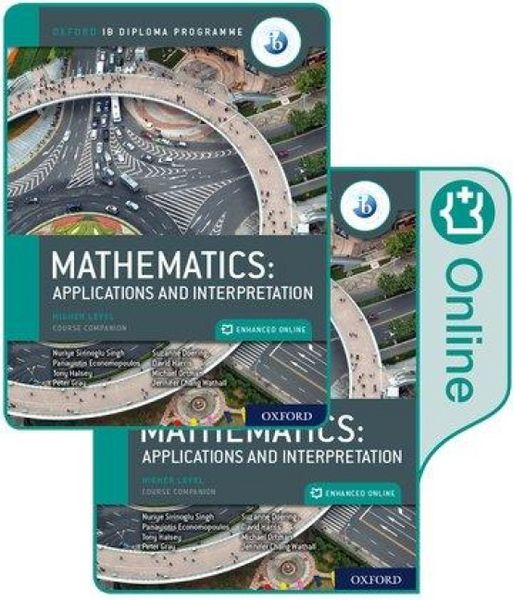
Produktbild: Oxford IB Diploma Programme: IB Mathematics: applications and interpretation, Higher Level, Print and Enhanced Online Course Book Pack

Oxford IB Diploma Programme: IB Mathematics: applications and interpretation, Higher Level, Print and Enhanced Online Course Book Pack

99,99 €

inkl. gesetzl. MwSt., Versandkostenfrei


Produktdetails

ISBN

978-0-19-842704-9

Erscheinungsdatum

21.03.2019

Bundesländer

Baden-Württemberg + weitere

Unterrichtsfächer

Mathematik

Klassenstufen

5. Klasse + weitere

Schulformen

Gymnasium

Einband

Taschenbuch

Verlag

Oxford Children's Books

Seitenzahl

832

Maße (L/B/H)

25,6/19,7/4,4 cm

Gewicht

1766 g

Sprache

Englisch

Produktdetails

ISBN

978-0-19-842704-9

Erscheinungsdatum

21.03.2019

Bundesländer

  • Baden-Württemberg
  • Bayern
  • Berlin
  • Brandenburg
  • Bremen
  • Hamburg
  • Hessen
  • Mecklenburg-Vorpommern
  • Niedersachsen
  • Nordrhein-Westfalen
  • Rheinland-Pfalz
  • Saarland
  • Sachsen
  • Sachsen-Anhalt
  • Schleswig-Holstein
  • Thüringen

Unterrichtsfächer

Mathematik

Klassenstufen

  • 5. Klasse
  • 6. Klasse
  • 7. Klasse
  • 8. Klasse
  • 9. Klasse
  • 10. Klasse
  • 11. Klasse
  • 12. Klasse
  • 13. Klasse

Schulformen

Gymnasium

Einband

Taschenbuch

Verlag

Oxford Children's Books

Seitenzahl

832

Maße (L/B/H)

25,6/19,7/4,4 cm

Gewicht

1766 g

Sprache

Englisch

Herstelleradresse

Libri GmbH
Europaallee 1
36244 Bad Hersfeld
DE

Email: GPSR Kontakt

Dazu passende Produkte

Noch keine Bewertungen vorhanden

Verfassen Sie die erste Bewertung zu diesem Artikel

Helfen Sie anderen Kundinnen und Kunden durch Ihre Meinung.

Kundinnen und Kunden meinen

Bewertungen (0)

Weitere Artikel findest du in

  • Produktbild: Oxford IB Diploma Programme: IB Mathematics: applications and interpretation, Higher Level, Print and Enhanced Online Course Book Pack
    • Measuring space: accuracy and geometry
    • 1.1: Representing numbers exactly and approximately
    • 1.2: Angles and triangles
    • 1.3: three-dimensional geometry
    • Representing and describing data: descriptive statistics
    • 2.1: Collecting and organizing data
    • 2.2: Statistical measures
    • 2.3: Ways in which we can present data
    • 2.4: Bivariate data
    • Dividing up space: coordinate geometry, lines, Voronoi diagrams, vectors
    • 3.1: Coordinate geometry in 2 and 3 dimensions
    • 3.2: The equation of a straight line in 2 dimensions
    • 3.3: Voronoi diagrams
    • 3.4: Displacement vectors
    • 3.5: The scalar and vector product
    • 3.6: Vector equations of lines
    • Modelling constant rates of change: linear functions and regressions
    • 4.1: Functions
    • 4.2: Linear models
    • 4.3: Inverse functions
    • 4.4: Arithmetic sequences and series
    • 4.5: Linear regression
    • Quantifying uncertainty: probability
    • 5.1: Theoretical and experimental probability
    • 5.2: Representing combined probabilities with diagrams
    • 5.3: Representing combined probabilities with diagrams and formulae
    • 5.4: Complete, concise and consistent representations
    • Modelling relationships with functions: power and polynomial functions
    • 6.1: Quadratic models
    • 6.2: Quadratic modelling
    • 6.3: Cubic functions and models
    • 6.4: Power functions, inverse variation and models
    • Modelling rates of change: exponential and logarithmic functions
    • 7.1: Geometric sequences and series
    • 7.2: Financial applications of geometric sequences and series
    • 7.3: Exponential functions and models
    • 7.4: Laws of exponents - laws of logarithms
    • 7.5: Logistic models
    • Modelling periodic phenomena: trigonometric functions and complex numbers
    • 8.1: Measuring angles
    • 8.2: Sinusoidal models: f(x) = asin(b(x-c))+d
    • 8.3: Completing our number system
    • 8.4: A geometrical interpretation of complex numbers
    • 8.5: Using complex numbers to understand periodic models
    • Modelling with matrices: storing and analyzing data
    • 9.1: Introduction to matrices and matrix operations
    • 9.2: Matrix multiplication and properties
    • 9.3: Solving systems of equations using matrices
    • 9.4: Transformations of the plane
    • 9.5: Representing systems
    • 9.6: Representing steady state systems
    • 9.7: Eigenvalues and eigenvectors
    • Analyzing rates of change: differential calculus
    • 10.1: Limits and derivatives
    • 10.2: Differentiation: further rules and techniques
    • 10.3: Applications and higher derivatives
    • Approximating irregular spaces: integration and differential equations
    • 11.1: Finding approximate areas for irregular regions
    • 11.2: Indefinite integrals and techniques of integration
    • 11.3: Applications of integration
    • 11.4: Differential equations
    • 11.5: Slope fields and differential equations
    • Modelling motion and change in 2D and 3D: vectors and differential equations
    • 12.1: Vector quantities
    • 12.2: Motion with variable velocity
    • 12.3: Exact solutions of coupled differential equations
    • 12.4: Approximate solutions to coupled linear equations
    • Representing multiple outcomes: random variables and probability distributions
    • 13.1: Modelling random behaviour
    • 13.2: Modelling the number of successes in a fixed number of trials
    • 13.3: Modelling the number of successes in a fixed interval
    • 13.4: Modelling measurements that are distributed randomly
    • 13.5: Mean and variance of transformed or combined random variables
    • 13.6: Distributions of combined random variables
    • Testing for validity: Spearman's hypothesis testing and x^2 test for independence
    • 14.1: Spearman's rank correlation coefficient
    • 14.2: Hypothesis testing for the binomial probability, the Poisson mean and the product moment correlation coefficient
    • 14.3: Testing for the mean of a normal distribution
    • 14.4: Chi-squared test for independence
    • 14.5: Chi-squared goodness-of-fit test
    • 14.6: Choice, validity and interpretation of tests
    • Optimizing complex networks: graph theory
    • 15.1: Constructing graphs
    • 15.2: Graph theory for unweighted graphs
    • 15.3: Graph theory for weighted graphs: the minimum spanning tree
    • 15.4: Graph theory for weighted graphs - the Chinese postman problem
    • 15.5: Graph theory for weighted graphs - the travelling salesman problem
    • Exploration