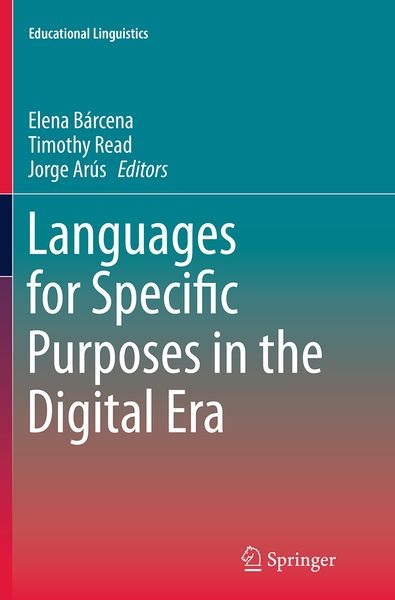
Produktbild: Languages for Specific Purposes in the Digital Era

Languages for Specific Purposes in the Digital Era

Aus der Reihe Educational Linguistics

141,99 €

inkl. gesetzl. MwSt., Versandkostenfrei

Lieferung nach Hause

Beschreibung

Produktdetails

ISBN

978-3-319-37850-3

Auflage

Softcover reprint of the original 1st ed. 2014

Erscheinungsdatum

03.09.2016

Unterrichtsfächer

Englisch

Einband

Taschenbuch

Herausgeber

Elena Bárcena + weitere

Verlag

Springer

Seitenzahl

348

Maße (L/B/H)

23,5/15,5/2 cm

Gewicht

573 g

Sprache

Englisch

Beschreibung

Produktdetails

ISBN

978-3-319-37850-3

Auflage

Softcover reprint of the original 1st ed. 2014

Erscheinungsdatum

03.09.2016

Unterrichtsfächer

Englisch

Einband

Taschenbuch

Herausgeber

Verlag

Springer

Seitenzahl

348

Maße (L/B/H)

23,5/15,5/2 cm

Gewicht

573 g

Sprache

Englisch

Herstelleradresse

Springer-Verlag KG
Sachsenplatz 4-6
1201 Wien
AT

Email: [email protected]

Kundinnen und Kunden meinen

0 Bewertungen

Informationen zu Bewertungen

Zur Abgabe einer Bewertung ist eine Anmeldung im Konto notwendig. Die Authentizität der Bewertungen wird von uns nicht überprüft. Wir behalten uns vor, Bewertungstexte, die unseren Richtlinien widersprechen, entsprechend zu kürzen oder zu löschen.

Die Bewertungen sind nach Format, Anzahl Sterne und Datum sortiert.

Verfassen Sie die erste Bewertung zu diesem Artikel

Helfen Sie anderen Kund*innen durch Ihre Meinung

Kundinnen und Kunden meinen

0 Bewertungen filtern

  • Produktbild: Languages for Specific Purposes in the Digital Era
  • Preface by Elena Bárcena, Timothy Read and Jorge Arús.- Section 1: General issues about learning languages with computers. Information Technology and Languages for Specific Purposes in the EHEA: Options and Challenges for the knowledge society by Elisabet Arnó-Macià. Fostering Learner Autonomy in Technology-Enhanced ESP Courses by Ana Gimeno Sanz. A blended learning proposal for professional English integrating Moodle with classroom work for the practice of oral skills by Elena Martín-Monje, Noa Talavá. Student Assessment in the Online Language Learning Materials developed and delivered through the ingenio system by Ana Sevilla Pavón, Antonio Martínez Sáez,José Macario De Siqueira.- Section 2: Computer-assisted experiences for the development of language competences and skills. Internet Dictionaries for Teaching and Learning Business English in Spanish Universities by Pedro A. Fuertes-Olivera. Moodle Glossary Tasks for Teaching Legal English by Ruth Breeze. Promoting Specialised Vocabulary Learning through Computer-Assisted Instruction by Mª Dolores Perea-Barberá, Ana Bocanegra-Valle. A Practical Application of Wikis for Learning Business English as Second Language by Pilar Rodríguez Arancón.- Section 3: Corpus-based approaches to/ applications for teaching and processing languages. A Genre-Based Approach to the Teaching of Legal and Business English: the GENTT Specialized Corpus in the LSP Classroom by Anabel Borja Albi, Natividad Juste Vidal, Mª del Pilar Ordóñez, Tomás Conde. Innovative methods for LSP-teaching: how we use corpora to teach business Russian by James Wilson, Serge Sharoff, Paul Stephenson, Anthony Hartley. Automatic specialized vs. non-specialized text differentiation: the usability of grammatical features in a Latin multilingual context by M.Teresa Cabre, Irid da Cunha, Eric SanJuan, Juan-Manuel Torres Moreno, Jorge Vivaldi. Exploring the Potential of Corpus Use in Translation Training: New Approaches for Incorporating Software in Danish Translation Course Design by Anne Lise Laursen.- Section 4: Processing natural languages. Representing environmental knowledge in EcoLexicon by Pamela Faber, Pilar León Araúz, Arianne Reimerink. New approaches to audiovisual translation: the usefulness of corpus-based studies for the teaching of dubbing and subtitling by Juan Pedro Rica Peramingo, Reyes Albarrán Martín, Blanca García Riaza. The pragmatic level of OntoLingAnnot’s ontologies and their use in pragmatic annotation for language teaching by Antonio Pareja Lora. Reflections on the future of technology-mediated LSP research and education by Jorge Arús, Elena Bárcena, Timothy Read