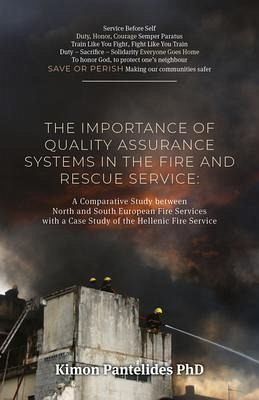
The Importance of Quality Assurance Systems in the Fire and Rescue Service (eBook, ePUB)
A Comparative Study between North and South European Fire Services with a Case Study of the Hellenic Fire Service
Erscheint vor. 31.12.25
4,99 €
inkl. MwSt.
Unser Service für Vorbesteller - dein Vorteil ohne Risiko:
Sollten wir den Preis dieses Artikels vor dem Erscheinungsdatum senken, werden wir dir den Artikel bei der Auslieferung automatisch zum günstigeren Preis berechnen.

PAYBACK Punkte
2 °P sammeln!

Fire services around the world share one common objective, to protect life and property. Although they have a variation of functions covered under their mission statements, the protection of life and property is a universal objective irrespective of nationality.However, the way this crucial objective is addressed from country to country, and even between fire services within the same country, varies significantly.As such, there is little homogeneity in how fire services operate. Despite empirical evidence and a wealth of experience documented in books, manuals and training guides, establishing...
Fire services around the world share one common objective, to protect life and property. Although they have a variation of functions covered under their mission statements, the protection of life and property is a universal objective irrespective of nationality.
However, the way this crucial objective is addressed from country to country, and even between fire services within the same country, varies significantly.
As such, there is little homogeneity in how fire services operate. Despite empirical evidence and a wealth of experience documented in books, manuals and training guides, establishing a broadly defined methodology towards effective emergency management and response, the status quo globally precludes the creation of an international benchmark for fire and rescue services.
This book attempts to establish a global benchmark to which fire services and their performance can be measured. It is acknowledged that due to intrinsic differences between fire services, such as funding capacity and risk needs, would deem the adoption of a uniquely homogenous standard, even in Europe, unfeasible. Therefore, it is a set of best practice principles that are being suggested that will invariably assist in improving fire service performance.
However, the way this crucial objective is addressed from country to country, and even between fire services within the same country, varies significantly.
As such, there is little homogeneity in how fire services operate. Despite empirical evidence and a wealth of experience documented in books, manuals and training guides, establishing a broadly defined methodology towards effective emergency management and response, the status quo globally precludes the creation of an international benchmark for fire and rescue services.
This book attempts to establish a global benchmark to which fire services and their performance can be measured. It is acknowledged that due to intrinsic differences between fire services, such as funding capacity and risk needs, would deem the adoption of a uniquely homogenous standard, even in Europe, unfeasible. Therefore, it is a set of best practice principles that are being suggested that will invariably assist in improving fire service performance.
Dieser Download kann aus rechtlichen Gründen nur mit Rechnungsadresse in A, D ausgeliefert werden.
Andere Kunden interessierten sich für