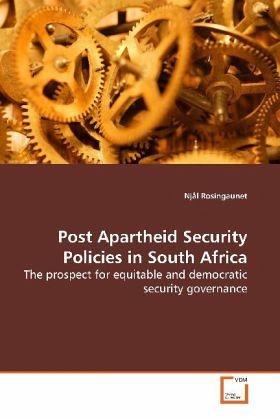
Post Apartheid Security Policies in South Africa
The prospect for equitable and democratic security governance
Versandkostenfrei!
Versandfertig in 6-10 Tagen
52,99 €
inkl. MwSt.

PAYBACK Punkte
26 °P sammeln!

This book sets out to explore an alternative, nodalmanner of comprehending and providing securitygovernance in South Africa. To provide a soundargument for this alternative route of nodalgovernance it approaches the subject matter byanalysing the trajectory of the South Africanpolicing policies (1990-2006), the social anddemocratic consequences thereof, and by conductingtwo case studies which serve the purpose of depictinghow security is governed in an urban and a ruralcommunity. The book argues that security governancecannot and should not be conceived through adichotomised state-society rela...
This book sets out to explore an alternative, nodal
manner of comprehending and providing security
governance in South Africa. To provide a sound
argument for this alternative route of nodal
governance it approaches the subject matter by
analysing the trajectory of the South African
policing policies (1990-2006), the social and
democratic consequences thereof, and by conducting
two case studies which serve the purpose of depicting
how security is governed in an urban and a rural
community. The book argues that security governance
cannot and should not be conceived through a
dichotomised state-society relationship. It argues
that governmental agencies in rural areas employ
control measures in order to improve service
delivery, whereas the sole focus upon efficiency
circumscribes the poor and marginalised potential of
deepening democracy concomitantly to establish more
equitable security governance. It also provides a
proposal to deepen nodal governance theory with double agents as change agents . This book will be
of interest for students and scholars of political
science, for those whom have their interest in
Africa, in safety and security, and the theory of
nodal governance.
manner of comprehending and providing security
governance in South Africa. To provide a sound
argument for this alternative route of nodal
governance it approaches the subject matter by
analysing the trajectory of the South African
policing policies (1990-2006), the social and
democratic consequences thereof, and by conducting
two case studies which serve the purpose of depicting
how security is governed in an urban and a rural
community. The book argues that security governance
cannot and should not be conceived through a
dichotomised state-society relationship. It argues
that governmental agencies in rural areas employ
control measures in order to improve service
delivery, whereas the sole focus upon efficiency
circumscribes the poor and marginalised potential of
deepening democracy concomitantly to establish more
equitable security governance. It also provides a
proposal to deepen nodal governance theory with double agents as change agents . This book will be
of interest for students and scholars of political
science, for those whom have their interest in
Africa, in safety and security, and the theory of
nodal governance.
Andere Kunden interessierten sich für