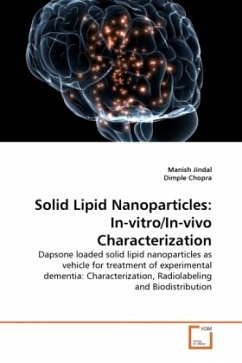
Solid Lipid Nanoparticles: In-vitro/In-vivo Characterization
Dapsone loaded solid lipid nanoparticles as vehicle for treatment of experimental dementia: Characterization, Radiolabeling and Biodistribution
Versandkostenfrei!
Versandfertig in 6-10 Tagen
32,99 €
inkl. MwSt.

PAYBACK Punkte
16 °P sammeln!

Delivery of drugs to the brain is a major challenge due to the presence of the blood brain barrier. To reach therapeutic drug level in the brain, nanoparticulate systems are being recently investigated as potential drug carriers due to their high loading capacity, small particle size and ability to bypass the Reticulo Endothelial System. Nanoparticles in fact, are solid colloidal particles ranging in size from 1 to 1000 nm and are composed of macromolecular material which could be polymeric or lipidic. Solid lipid nanoparticles (SLNs) are taken up readily by the brain because of their lipidic ...
Delivery of drugs to the brain is a major challenge due to the presence of the blood brain barrier. To reach therapeutic drug level in the brain, nanoparticulate systems are being recently investigated as potential drug carriers due to their high loading capacity, small particle size and ability to bypass the Reticulo Endothelial System. Nanoparticles in fact, are solid colloidal particles ranging in size from 1 to 1000 nm and are composed of macromolecular material which could be polymeric or lipidic. Solid lipid nanoparticles (SLNs) are taken up readily by the brain because of their lipidic nature. The bioacceptable and biodegradable nature of SLNs makes them less toxic as compared to polymeric nanoparticles. SLN have been found to improve the permeability of drug through the blood brain-barrier and is a promising drug targeting system for the treatment of central nervous system disorders.
Andere Kunden interessierten sich für